

A ductless fume hood is a self-contained enclosure that filters chemical fumes internally and recirculates clean air to the room, requiring nothing more than a standard power outlet — no building exhaust connection, no HVAC modification, no construction delay.
Key facts at a glance
| Feature | Detail |
|---|---|
| Primary protection mechanism | Recirculating air through internal filtration media |
| Filter types | Activated carbon for chemical vapors; HEPA for particulate filtration; some units combine both |
| Installation requirement | Many portable units require no ductwork and operate from standard electrical outlets |
| Airflow performance | Depends on hood design, filter type, and manufacturer specifications |
| Best-fit applications | Low-to-moderate hazard chemicals, teaching laboratories, and field applications |
| Not suitable for | High-toxicity, carcinogenic, or unknown chemical hazards without proper engineering controls |
| Filter replacement interval | Depends on chemical load, usage frequency, and manufacturer recommendations |
| Relevant considerations | OSHA requirements, chemical compatibility, and manufacturer performance data |
What a Ductless Fume Hood Actually Is
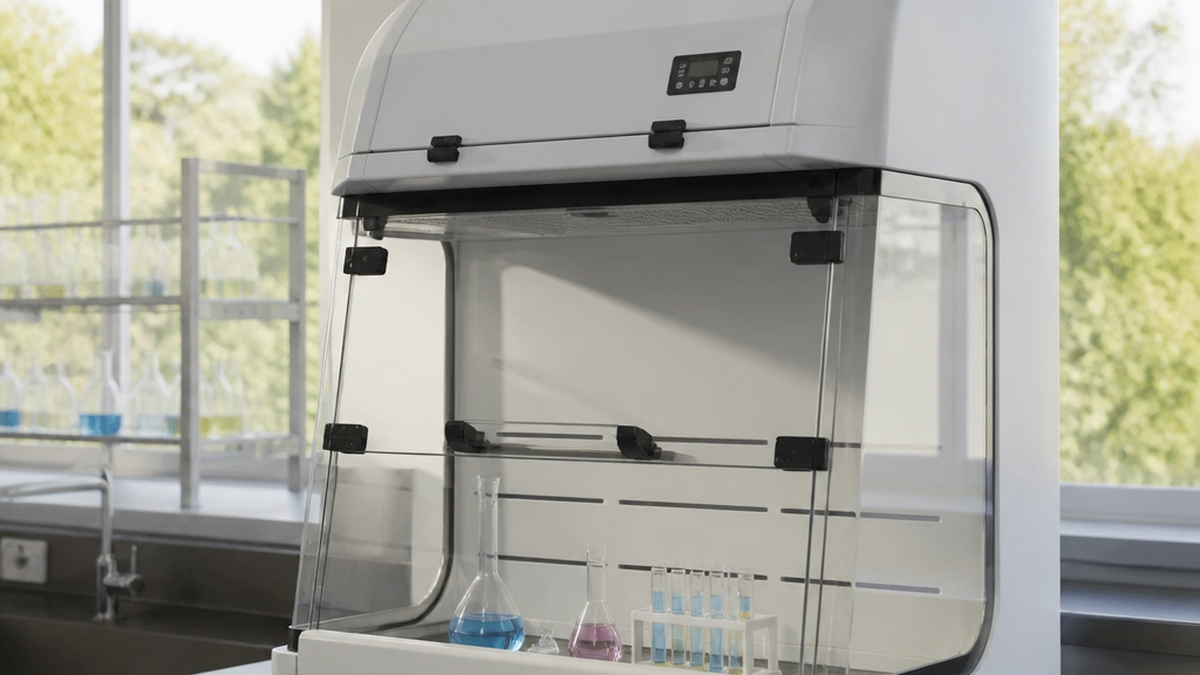
A ductless fume hood is a self-contained laboratory enclosure that draws contaminated air through internal filters and returns clean air to the room — no external exhaust duct required. Unlike a standard ducted hood that pushes chemical fumes outside the building, a ductless unit processes the air internally and recirculates it.
The working principle is simple: a fan pulls room air in through the front opening, captures chemical vapors and particulate inside the filter pack, then releases filtered air back into the lab. The result is a portable containment solution that works wherever there’s a power outlet — making it practical for portable lab safety equipment applications where permanent infrastructure doesn’t exist.
📌 Remember: “Ductless” means the hood doesn’t connect to building HVAC. The air stays in the room — filtered, not exhausted. That distinction matters when evaluating whether the unit fits your chemical profile.
How the Structure Controls Performance
Every ductless fume hood shares the same core architecture, even if the form factor varies.
Primary structural components:
- Work zone / chamber — the enclosed workspace; typically polypropylene or powder-coated steel for chemical resistance
- Sash — a movable transparent panel (usually polycarbonate or tempered glass) that controls the front opening and face velocity
- Filter housing — the top or rear compartment holding one or multiple filter cartridges
- Fan/blower unit — draws air upward through the filter pack at a controlled rate
- Exhaust grille or return plenum — where filtered air re-enters the room
- Electrical controls — airflow speed, LED lighting, and often a digital face velocity display
Some configurations use a bench-mounted or stand-alone form factor without a base cabinet — common in teaching environments where mobility matters.
The sash position affects airflow behavior and containment performance. Manufacturers typically specify the recommended sash opening height and operating airflow for each hood design. Keeping the sash at the recommended position helps maintain proper containment and user protection.

The Working Principle — and the Counterintuitive Limit Most Buyers Miss
The working principle is airflow containment through filtration. A blower draws contaminated air inward through the sash opening and passes it through the filter system before returning filtered air to the room.
Contaminated air travels through the filter pack, where chemical vapors are captured by activated carbon and particles may be removed by HEPA or pre-filter stages. The effectiveness depends on proper filter selection and airflow control.
Face velocity is an important performance parameter. Many laboratory fume hood designs operate within approximately 80–120 FPM, but the correct operating range depends on hood design, application requirements, and validation testing.
Higher airflow is not always better. Excessive velocity can create turbulence around the sash opening and may reduce containment performance depending on the hood design and laboratory conditions.
The goal is stable, controlled inward airflow within the validated operating range rather than simply maximizing fan speed.
⏱️ Time saver: Most modern ductless fume hoods include a continuous airflow monitor with an audible alarm. If face velocity drops below threshold — due to a clogged filter or a door left ajar — the alarm triggers before exposure risk increases. Confirm this feature is present before purchasing.
Third-party testing under ASHRAE 110 containment protocols shows that properly maintained ductless units achieve equivalent containment to ducted hoods for qualifying chemical classes. The critical variable is filter match — the activated carbon formulation must be selected for the specific compound family in use.
Filter Selection: The Single Most Consequential Decision
Filter selection is one of the most important factors affecting ductless fume hood performance. The wrong filter media may provide little or no protection for certain chemicals, and breakthrough cannot always be detected by smell or appearance alone.
| Filter Type | Target Contaminants | Typical Applications |
|---|---|---|
| Standard activated carbon | Many organic vapors, solvents, and volatile compounds | General solvent handling and organic chemistry applications |
| Acid-treated carbon | Acid gases and some acidic vapors | Applications involving acids or corrosive vapors |
| Impregnated carbon (specialized media) | Specific chemicals such as mercury vapor or selected reactive compounds | Specialized chemical handling requiring dedicated adsorption media |
| HEPA filter | Airborne particles, aerosols, and fine particulate matter | Powder handling, biological materials, and particulate control |
| Combination filter (carbon + HEPA) | Chemical vapors and particulate contaminants together | Applications requiring both vapor adsorption and particle filtration |
Carbon filters have a limited adsorption capacity and gradually become less effective as they accumulate contaminants. Filter replacement should be based on chemical exposure, usage conditions, manufacturer recommendations, and monitoring data rather than smell alone.
A saturated or exhausted filter may no longer provide reliable protection, even if the airflow system continues operating normally. Keeping accurate filter replacement records is essential for safe operation.
⚖️ Trade-off: Combination filter systems generally increase initial cost and may require more frequent replacement because multiple filter stages are involved. For applications involving both chemical vapors and particles, this added protection can be valuable. For single-purpose vapor applications, a correctly selected carbon filter system may provide a simpler and lower-maintenance solution.
Where Ductless Fume Hoods Fit — and Where They Don’t
Ductless fume hoods fit situations where ducted infrastructure is absent, temporary, or impractical.
Common applications:
- Teaching and university labs — room layouts change semester to semester; permanent ductwork isn’t proportionate to the need
- Industrial quality control — bench-level work with solvents, reagents, or acids in a QC lab adjacent to a production floor
- Field and mobile labs — portable units can operate from standard electrical supplies, making them suitable for temporary sites where fumes must be controlled without fixed infrastructure
- Pharmaceutical compounding — low-volume organic compound work where a full ducted installation isn’t warranted by scale
- High school and community college programs — HEPA-plus-carbon hoods cover standard curriculum chemicals safely at lower facility cost
R&D environments with well-characterized, stable chemical inventories are also reasonable candidates. When the compound family is known and a validated carbon filter match exists, a ductless unit performs reliably. For an overview of compatible containment options, see Huanawell’s laboratory safety cabinet line.
Why are ductless hoods not recommended for most general laboratory activities? Filter specificity. A ducted hood exhausts everything regardless of identity. A ductless hood only removes what its specific filter was designed for. Unknown or mixed chemical streams, highly toxic compounds, and carcinogens all demand the fail-safe certainty of outside exhaust.
FAQ
Do ductless fume hoods work?
Yes, ductless fume hoods work effectively when matched to the correct chemical application. They use activated carbon or specialty filters to capture vapors before recirculating air into the lab. Performance depends entirely on selecting the right filter type for the chemicals in use and replacing filters on schedule. Independent testing to ANSI/ASHRAE 110 standards confirms containment ability. For low-volume work with known chemicals, a properly maintained ductless hood provides reliable protection without requiring building ductwork.
What is the difference between a fume hood and a ductless fume hood?
A traditional ducted fume hood exhausts contaminated air outside the building through a dedicated ventilation system, while a ductless fume hood filters that air internally and returns it to the room. Ducted hoods handle a broader range of chemicals and higher volumes because there is no filter saturation risk. Ductless models offer installation flexibility and lower upfront cost but require strict chemical compatibility checks and regular filter replacement to maintain safe operation.
Why are ductless fume hoods not recommended for most laboratory activities?
Ductless fume hoods are not universally recommended because no single filter captures every chemical. Carcinogens, highly toxic compounds, unknown chemical mixtures, and high-volume solvent work exceed the safe capacity of most carbon filters. OSHA and many institutional safety officers require ducted exhaust for these scenarios because an overloaded or wrong-spec filter can allow breakthrough, exposing lab workers. They are appropriate only for documented low-hazard tasks with chemically compatible, regularly replaced filters.
Sources
[1] ashrae 110-2016 — kewaunee.com
[2] 1910.1450 App A – National Research Council… — osha.gov
[3] ANSI/ASHRAE 110: Laboratory Fume Hoods Performance… — blog.ansi.org
[4] SEFA 1-2010 Laboratory Fume Hoods — sefalabs.com
[5] UCI EH&S Position Statement Ductless Fume Hood Systems — ehs.uci.edu
[6] Ductless Fume Hood Review – ORS — ors.od.nih.gov


