
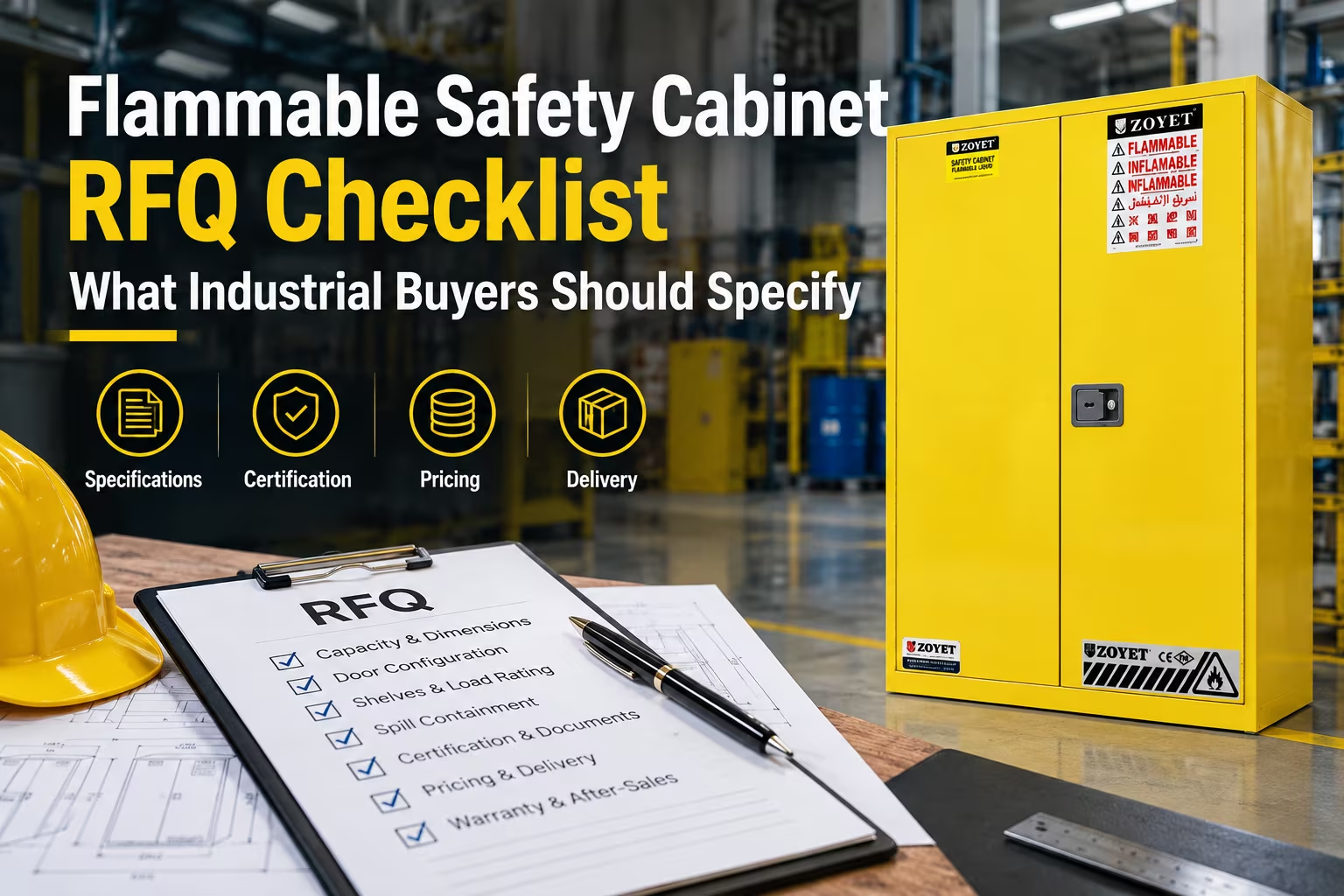
Several line items determine whether one flammable cabinet quotation can be compared fairly with another. If capacity, door configuration, certification scope, freight, or included hardware are left undefined, suppliers may quote materially different configurations and commercial terms.
That gap is why a buyer in Denver and a buyer in Phoenix can send the “same” request to the same supplier and get quotes hundreds of dollars apart (a $400 spread is easy to hit once freight and hardware drift), spec’d differently, with no way to line them up.
This Flammable Safety Cabinet RFQ Checklist: What Industrial Buyers Should Specify exists to close that gap. It’s built for procurement teams sourcing storage systems for chemical, oil and gas, transportation, and lab projects — people who need apples-to-apples quotes, not a sales brochure. The details buyers most often omit are the same handful every time: container class, sump volume, door type, and Incoterms.
State those four and half the confusion never starts.
For broader product-selection context before finalizing the RFQ, see our flammables storage cabinet guide.
At a glance
| Item | Detail |
|---|---|
| Define first | Stored liquids by class, container type and count, site environment, destination city/AHJ |
| Core specs to state | Capacity (gal), max footprint, door type, shelf count + load rating, sump volume |
| Construction to specify | Steel gauge, single/double wall, finish/color, lock type, grounding lug |
| Certification to request | Model-specific proof against OSHA 1910.106 / NFPA 30 (and FM/EN where applicable) |
| Documents to request | Dimensioned design drawing, spec sheet, installation documentation |
| Commercial to confirm | MOQ + price breaks, lead time, Incoterms, export-ready packaging, warranty, spare parts |
| Compare on | Technical + certification + commercial together — never unit price alone |
What to Define Before Requesting a Quote
Before you ask a single supplier for pricing, define what the cabinet is actually protecting. A quote is only as good as the storage problem you describe — and vague inputs guarantee vague, non-comparable outputs. To specify means to state a requirement precisely enough that two suppliers can’t read it two different ways.

Stored liquids and container types
List the liquids by name and class, not by generic “solvents.” A cabinet sized for sealed quart cans behaves differently from one holding open safety cans or 5-gallon pails. Container type drives shelf spacing, load rating, and how many the cabinet can actually hold.
State whether you need self-closing doors for a higher-hazard material, and note any corrosive or reactive contents — those may need a different cabinet type entirely. The flammable liquid classes in NFPA 30 are the shared vocabulary here; the same class definitions carry into OSHA 1910.106, so use them.
📌 Remember: If you can’t name the liquids, you can’t size the cabinet. Container count × container size is the single most useful line in the whole RFQ.
Installation environment and destination market
Tell the supplier where this cabinet lives and works. Indoor climate-controlled room, unheated warehouse, or near an outdoor loading dock — each changes finish and ventilation expectations. If the site sees corrosive fumes or wash-down, say so.
Destination matters because the project’s authority having jurisdiction (AHJ) enforces local fire safety rules. Name your city and applicable standard so the supplier quotes to the right requirement.
State and local fire codes can add requirements beyond federal OSHA, so identify the project location and AHJ rather than assuming one national door requirement.
Quote to the city, not to an average.
What Cabinet Specifications to Include in the RFQ
The specification section is the heart of a comparable quote. Nail capacity, doors, and shelving here and most quote confusion disappears. These are the values every supplier plugs into their pricing system, so leaving them blank invites assumptions.
Capacity and dimensions
Give both the gallon capacity and the maximum footprint your floor space allows. A supplier can hit a capacity target with several different cabinet sizes — if your aisle is 34 inches wide, say so, or you’ll get a unit that won’t fit through the door.
Include external dimensions (H×W×D) as a range if you have flexibility. Note floor loading limits for upper floors; a fully loaded cabinet exerts real point pressure through its feet, and a mezzanine designed for light duty may not take it.
Door configuration
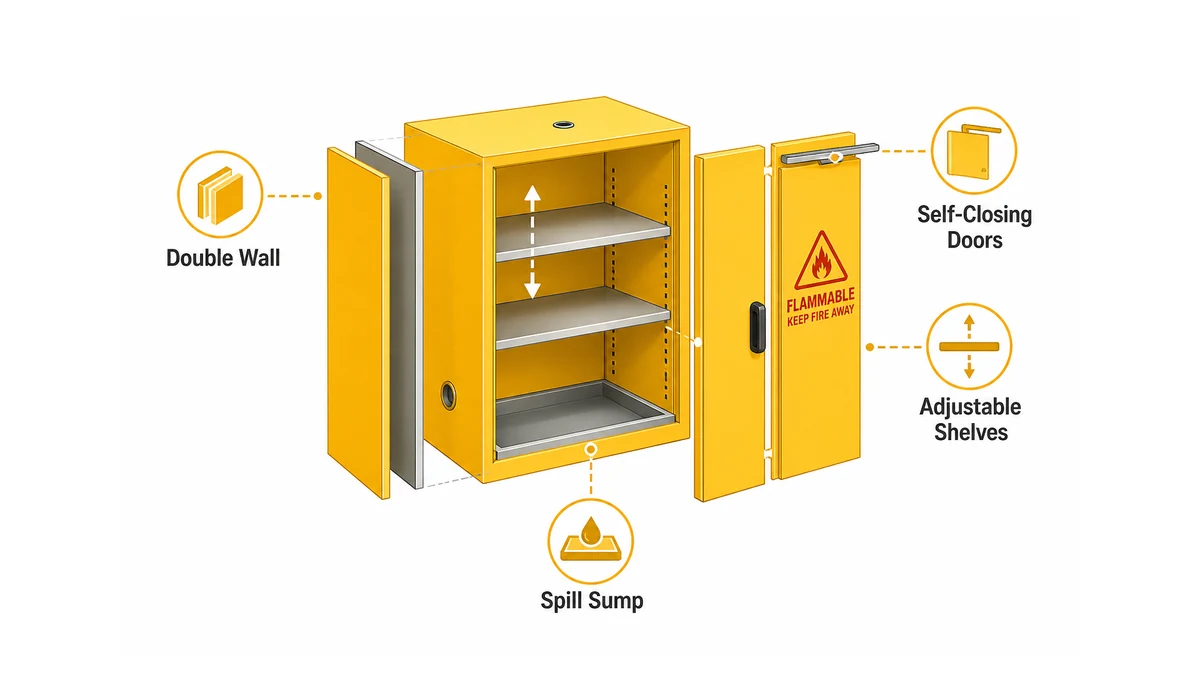
Specify manual-close or self-closing, and single- or double-door. Self-closing doors may be required by the applicable state or local fire code or by the project AHJ, so state that requirement explicitly in the RFQ. If a hold-open function is needed, ask the supplier to identify the listed or approved closing mechanism.
State the swing direction and clearance you have. A double-door cabinet needs more open-swing room than a compact single door.
Shelves, load rating, and spill containment
Specify the cabinet’s liquid-tight bottom, sill, or sump design and ask the supplier to state its containment capacity. Under OSHA 1910.106, a prescriptive metal cabinet has a door sill raised at least 2 inches above the cabinet bottom; FM Approved ignitable-liquid cabinets use a 2-inch-deep leak-tight sump or pan. Do not automatically apply SPCC bulk-storage containment sizing to an individual safety cabinet.
What Construction Details to Specify
Construction details are where quotes quietly diverge. Two cabinets can share a gallon rating and look identical in a photo while using different steel gauges, welds, and hardware. Spell out the build so price differences reflect real quality differences, not corner-cutting.
Cabinet construction and finish
State the steel gauge for the body and doors, and whether you require double-wall construction with an air gap for fire protection. Ask for the insulation type between walls. These drive both fire performance and shipping weight.
Specify the finish — powder-coat color, coating thickness, and any corrosion resistance you need. For harsh environments, ask whether a stainless steel option or upgraded coating is available and what it adds to the price. Note the required interior finish too.
⚖️ Trade-off: Heavier gauge steel and double-wall construction raise both fire protection and freight cost. For a lightly loaded indoor cabinet, the top-tier build may be more than the material inside it warrants — match the spec to the hazard.
Hardware, locks, and labeling
List the lock type: keyed, padlock hasp, or a system for controlled access. If several people need entry, say how many keys and whether keying should be alike across cabinets. Confirm hinge type and grounding provision — many buyers require a bonding lug and want it noted on the quote.
Labeling is easy to forget and slow to fix later. Specify the warning labels, language, and any custom facility signage. State whether hazard placards must match your site’s existing labeling system.
What Certification and Documents to Request
A cabinet is only as compliant as the paperwork proving it. Ask for certification tied to the exact model quoted — not a general company claim. This is where buyers get burned: a supplier holds a certificate for one model and quotes a different one.
Model-specific fire protection certification
Request the specific standards the quoted cabinet meets and documentary proof for that unit. Ask whether the listing carries an FM Approvals mark or the construction requirements of NFPA 30 cabinet design — an 18-gauge sheet-steel body and specified door clearances are the baseline many AHJs read against.
Confirm in writing that the certificate covers the model number on your quote.
If your project’s AHJ needs a particular listing, name it now. Retrofitting compliance after delivery is expensive and slow.
Technical documents and drawings
Ask for a dimensioned drawing, a spec sheet, and installation documentation with each quote. A drawing lets you verify fit before you commit and gives your facilities team a reference for placement.
Request the documentation format you need — a PDF spec sheet plus a CAD or dimensioned design drawing covers most procurement systems. Confirm whether labels, grounding details, and load ratings appear on the drawing.
What Commercial Terms to Confirm
Technical parity means nothing if the commercial terms don’t line up. Two identical cabinets at different Incoterms are not the same price — and a buyer who compares unit cost alone will pick the wrong supplier. Pin these terms in the RFQ so every quote answers the same questions.
Here’s the counterintuitive part.
The lowest unit price on the page is statistically the most likely to have freight excluded — because that’s exactly how a quote gets to be the lowest. The cheapest line is often the incomplete one, and only shows its true rank after you add the missing freight and hardware back in.

Quantity, MOQ, and pricing
State your order quantity and ask for the minimum order quantity (MOQ) and any price breaks. Unit price often drops sharply above a threshold; if you’re buying for multiple sites, aggregate the count and ask for tiered pricing.
Confirm what’s included in the unit price — shelves, grounding hardware, labels — versus what’s a line-item add. Hidden add-ons are the most common source of a quote that looks cheap and isn’t.
Lead time, Incoterms, and packaging
Ask for lead time in business days from PO, and whether it’s ex-works ready or delivered. Specify the Incoterms you want quoted so freight responsibility is unambiguous.
Packaging matters for freight damage and export. For cabinets shipped across the country or export-bound, ask about crating, palletizing, and export-ready packaging that survives DOT hazmat freight handling. A dented door on arrival is a lead-time reset.
⏱️ Time saver: Request lead time, MOQ, and Incoterms in the RFQ itself, not after the first quote round. Chasing these one at a time across three suppliers costs a week.
Warranty and spare parts
Confirm the warranty term and what it covers — structure, finish, hardware. Ask how warranty claims are handled given the shipping distance. Request spare-parts availability for shelves, latches, and hinges; these are the wear items that fail first, and a cabinet you can’t get a replacement latch for is a short-lived asset.
How to Handle Supplier Deviations
No supplier will match every RFQ line exactly, and that’s fine — as long as they tell you where they deviated. Make deviation reporting part of the request so you can compare on equal footing.
A quiet substitution is worse than a stated exception.
Compliant items vs. exceptions
Ask each supplier to mark every RFQ line as either “compliant as specified” or “exception,” with a note on any exception. This one requirement turns three incomparable quotes into a scoreable matrix. A supplier who offers a heavier gauge than requested is deviating too — you want to know.
Exceptions aren’t automatically bad. A supplier’s standard shelf load rating may exceed yours at no extra cost. But you can only credit that if it’s stated.
Assumptions and exclusions
Require each quote to list its assumptions and exclusions. If a supplier assumed indoor installation, standard color, or excluded freight, that belongs on the page — not discovered at delivery. Confirm whether installation, grounding hardware, and labeling are included or excluded. Assumptions are where scope quietly shrinks.
How to Compare Supplier Quotations
With a disciplined RFQ, comparison becomes a scoring exercise. Compare on three axes — technical, certification, commercial — never on unit price alone.
| Comparison axis | What to check | Red flag |
|---|---|---|
| Technical specifications | Gauge, capacity, doors, shelf load, sump volume match RFQ | “Standard model” with no gauge stated |
| Certification & documentation | Cert covers the quoted model; drawing + spec sheet included | Company-level claim, no model-specific proof |
| Commercial terms | Same Incoterms, MOQ, lead time, inclusions | Low unit price, freight and hardware excluded |
Score each supplier’s exceptions against the technical column first, verify the certification is model-specific before price enters the picture, then normalize every quote to the same Incoterms and inclusions. Add excluded freight, grounding hardware, and labeling back into any quote that omitted them. Then — and only then — rank by landed cost, lead time, and warranty.
Wuxi Huanawell (ZOYET) builds industrial safety storage to conform with OSHA 1910.106 and NFPA 30, and can identify which model carries FM or EN certification for a project’s AHJ. A supplier that answers every RFQ line — exceptions marked, model-specific documents attached — is the one whose paperwork holds up when an inspector questions it after delivery.
Bottom line: A tight RFQ is the cheapest quality-control tool a procurement team has. Define the liquids and site, specify capacity, construction and fire protection certification, and require suppliers to mark exceptions — and you’ll get quotes you can actually score. When you’re ready, request a model-specific quote with the dimensioned drawing and certification attached to the exact unit.
Want help cross-referencing a spec — capacity, gauge, certification, or export documentation — against your project’s requirements? Bring the checklist and your site details, and any line that needs a decision before you buy gets flagged.
Have a project or a spec sheet in hand? Talk to huanawell.com — real engineers answer.
Frequently asked questions
Can flammable safety cabinets be stacked?
Only use a stacking arrangement when the cabinet model is specifically designed and approved for that purpose. Some manufacturers offer add-on or piggyback cabinets engineered to mount above compatible base cabinets, while standard floor-standing cabinets may not be suitable for stacking. Before adding stacking to an RFQ, ask the supplier to confirm the approved configuration, compatible base model, maximum installed height, and any required anchoring hardware.
Can gasoline and oil be stored in the same flammable safety cabinet?
They may be stored together when the products are chemically compatible and the combined quantity remains within the applicable cabinet and site limits. Buyers should still check each product’s SDS before combining materials because hazard compatibility, not cabinet color alone, determines whether substances belong together. If incompatible or reactive materials are involved, specify separate storage in the RFQ.
Can a flammable safety cabinet be used outdoors?
A cabinet intended for indoor service should not automatically be specified for outdoor installation. Outdoor applications may require a cabinet designed for weather exposure, with appropriate corrosion protection and other features required by the site or local authority. When requesting a quote, state explicitly that the cabinet will be installed outdoors so the supplier does not quote a standard indoor model.
Does a flammable safety cabinet need to be anchored to the floor?
Not every indoor installation automatically requires floor anchoring. The need can depend on the cabinet design, installation location, site risk assessment, seismic requirements, and local rules. If anchoring is required for the project, include it in the RFQ and ask the manufacturer for the approved anchoring method rather than drilling or modifying the cabinet without guidance.
Sources
[1] Classifying Ignitible Liquids Using NFPA 30 — nfpa.org
[2] 1910.106 – Flammable liquids. — osha.gov
[3] 1926.152 – Flammable liquids. — osha.gov
[4] Chapter 4: Secondary Containment and Impracticability — epa.gov
[5] Item # FM28, Safety Flammable Cabinet – High Rise … — jamcoproducts.com
[6] NFPA 30 Section 9.5 Guide: Flammable Liquid Storage — ushazmatstorage.com
[7] Code of Federal Regulations Title 49. Transportation § … — codes.findlaw.com
[8] Flammable and Combustible Liquids: Containers, Cabinets … — grainger-prod.adobecqms.net


