

A plant safety manager in Ohio needs 40 flammable storage cabinets certified to FM 6050 before a Q1 audit — and the domestic lead time is 14 weeks. She finds three top flammable safety cabinet manufacturers in China quoting 5-week delivery at roughly 35–55% of the U.S. distributor list price — buyers commonly report landed costs in that range, though the exact figure varies by volume and configuration, so verify with current quotes. The hard question isn’t whether to source from China; it’s which manufacturer can actually back the spec, the paperwork, and the post-shipment support.
How We Selected These Manufacturers
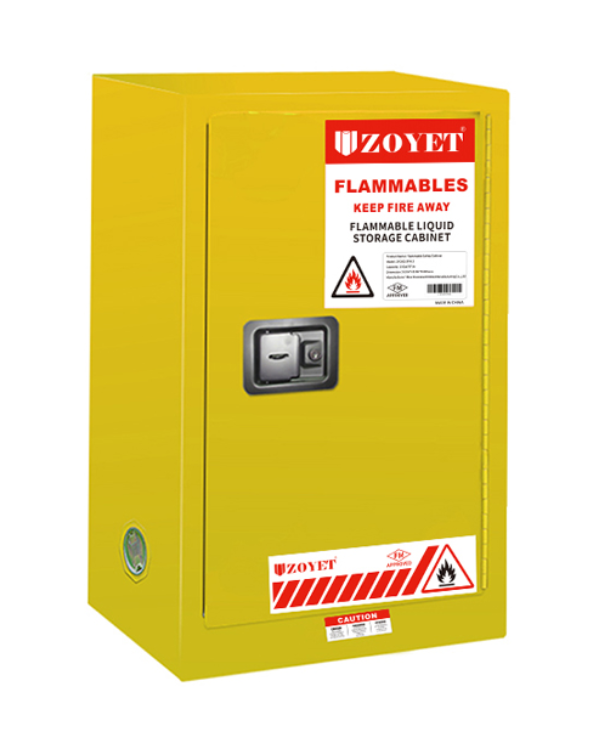
Founded in 2013 in Wuxi, Jiangsu, Huanawell (ZOYET) is a direct manufacturer of safety storage products — tested by the Jiangsu Institute of Metrology (JSMI) — with a product line spanning flammable cabinets, acid and corrosive storage, outdoor explosion-proof containers, and spill containment pallets. That production breadth, across chemical hazard classes and export markets, shaped the criteria below. They reflect what gets a storage cabinet through a U.S. facility inspection — not a supplier-ranking algorithm.
For buyers comparing flammable safety cabinet options, the criteria below are where vetting always starts.
FM Approval, EN 14470-1, and Applicable Safety Requirements
FM 6050[1] is the dominant certification for flammable liquid storage cabinets sold into U.S. industrial facilities. NFPA 30[2] and OSHA 29 CFR 1910.106[3] govern how flammable liquids must be stored; an FM-approved cabinet satisfies the equipment side of both requirements. The EN 14470-1[4] standard covers European markets and tests fire resistance at 90 minutes.
When evaluating FM-approved safety cabinets, verify that the certificate number is live — not expired or from a one-time prototype test.
Product Range and Manufacturing Capability
A genuine cabinet manufacturer controls its own sheet-metal fabrication, powder coating, and assembly line — verifiable production lead times and the ability to modify shelf heights, vent locations, or door configurations for OEM orders follow from that. Look for manufacturers that carry at least a full-sized 45-gallon and 90-gallon flammable liquid storage cabinet in standard production, not just catalogue images.
Manufacturers that also produce acid and corrosive storage cabinets, chemical storage cabinets for mixed inventories, and spill containment pallets demonstrate hazardous materials management breadth. That matters for a procurement manager consolidating a full chemical safety storage order into one shipment.
Export Experience, OEM Capability, and Documentation Support
A factory that ships one container a year to the U.S. is not the same as one that routinely prepares compliant SDS packs, country-of-origin documents, and inspection certificates. OEM capability — private-label silk-screening, custom RAL colors, buyer-branded warning labels — is a separate competency from manufacturing. Confirm both.
⏱️ Time saver: Ask for a sample certificate of conformity and a packing list from a prior U.S. shipment on your first call — a capable exporter produces both in under 24 hours.
Leading Chinese Flammable Safety Cabinet Manufacturers
Wuxi Huanawell (ZOYET)
Founded in 2013, Huanawell exports compliant safety storage products to U.S. industrial customers. The product line covers flammable safety cabinets, acid and corrosive storage cabinets, outdoor explosion-proof containers, narcotic cabinets, and spill containment pallets. Cabinets conform to OSHA, NFPA, FM, and EN standards, and the factory is tested by the Jiangsu Institute of Metrology (JSMI) — a third-party verification step many smaller Chinese factories skip.
Clients include contractors, chemical manufacturers, military, government, energy, oil and gas, and pharmaceutical sectors globally.
OEM and private-label orders are a core part of the production schedule. Label localization — OSHA-compliant pictograms, English warning text, FM mark placement — is handled in-house.
SYSBEL
SYSBEL is a Guangdong-based safety storage brand. Their flammable storage cabinet line includes 4-gallon, 22-gallon, 45-gallon, and 90-gallon models, and their chemical storage cabinet and spill pallet range is broad enough to support consolidated orders. They claim FM and CE documentation; request current certificate numbers and expiry dates before committing to a bulk order.
KDM Safety
KDM operates out of Foshan, Guangdong, manufacturing industrial safety storage products including flammable liquid cabinets, corrosive storage cabinets, and gas cylinder safety cabinets. English-language product documentation is available. As with any export-focused supplier, request the actual FM Approval report number and cross-check it on the FM Approvals product finder before placing an order.
BOKA LAB
BOKA LAB focuses on laboratory-grade safety storage — biological safety cabinets, laboratory glove boxes, chemical fume hoods, auto dry cabinets, nitrogen dry boxes, and laboratory drying ovens. If your facility’s chemical storage requirement includes a laboratory environment rather than a plant floor, BOKA LAB covers lab-specific SKUs that a pure industrial cabinet manufacturer will not carry. Their products are positioned toward research institutions, pharmaceutical labs, and university facilities.
Other Flammable Safety Cabinet Manufacturers Worth Evaluating
China’s Yangtze River Delta and Pearl River Delta regions host a significant concentration of metal-fabrication plants producing safety storage equipment. Justrite China (the domestic production arm of the U.S. brand) and several Zhejiang-based factories supply OEM product to multiple Western labels. For wholesale or large-volume private-label orders, Alibaba’s verified supplier tier and Canton Fair exhibits are starting points — factory audits remain non-negotiable.
Manufacturer Comparison at a Glance
| Manufacturer | FM / EN Certification | Key Product Range | OEM / Private Label | Primary Market |
|---|---|---|---|---|
| Wuxi Huanawell (ZOYET) | FM, NFPA, EN, OSHA, JSMI-tested | Flammable cabinets, acid cabinets, explosion-proof containers, spill pallets | Yes — in-house | U.S., EU, global industrial |
| SYSBEL | FM, CE (verify current cert) | Flammable cabinets, spill pallets, chemical storage | Yes | China domestic + export |
| KDM Safety | CE, claims FM (verify) | Flammable, corrosive, gas cylinder cabinets | Yes | Export-focused |
| BOKA LAB | CE, lab standards | Biological safety cabinets, fume hoods, glove boxes, dry cabinets | Limited | Lab / pharma / research |
Construction, Door, Spill Containment, and Venting Features
The OSHA construction specification[3] requires double-wall steel with a 1.5-inch air space, 18-gauge minimum steel, and a bottom sump with at least 2-inch capacity for spill containment. Self-closing, self-latching doors with a 3-point latch system are required.
Venting knockout ports should be present but plugged at factory — NFPA 30[2] does not require venting, and unvented cabinets perform better in most fire tests. Ask for the steel gauge certificate on the material used. Some lower-cost factories substitute 20-gauge on the inner wall, which fails the OSHA minimum.
Certification and Compliance Documentation
Beyond the certificate itself, a compliant manufacturer should provide: the FM Approval listing number, the test report reference, a declaration of conformity, and the standard version tested against. For U.S. imports, country-of-origin marking and HS code documentation (typically HS 9403.20 for metal furniture) need to be correct to clear customs without delay.
Certificates expire. Pull the certificate number and verify it directly on the issuing body’s database — not from the manufacturer’s website PDF.
⚖️ Trade-off: Lower MOQ from a trading company means faster entry but no control over which factory actually made the cabinet — a problem when a customer requests the original test report.
What Types of Safety Cabinets Do These Manufacturers Produce?
Flammable Liquid Storage Cabinets
The core safety storage product. Used for storing Class I, II, and IIIA flammable liquids[5] — solvents, fuels, paints, adhesives. Sizes range from 4-gallon benchtop units to 90-gallon full-height floor cabinets with two adjustable shelves and a 2-inch spill sump. Yellow is the ANSI standard color for flammable storage; red is used by some manufacturers for gasoline and fuel products.
Acid and Corrosive Storage Cabinets
Corrosive storage cabinets are not interchangeable with flammable storage cabinets. Storing acids in a steel-interior flammable cabinet causes accelerated corrosion and potential structural failure. Corrosive storage units are constructed with polyethylene or polypropylene-lined interiors — the choice of liner material matters: polypropylene handles concentrated sulfuric and nitric acid better than standard HDPE, which degrades under prolonged contact with oxidizing acids.
OSHA 29 CFR 1910.101[3] addresses compressed gas handling, and NFPA 400[2] provides the segregation requirements that determine when acids must be physically separated from flammables rather than simply stored in different cabinet types in the same room. Standard color coding is white or blue for corrosive storage.
Chemical Storage Cabinets for Mixed Inventories
Some facilities store chemicals that span multiple hazard classes — a combined flammable and oxidizer risk, or corrosive and flammable materials that must be segregated within one storage room. OSHA 1910.106(d)(3)[3] addresses separation requirements for mixed hazards. Dual-compartment chemical storage cabinets and modular locker-style safety storage systems address this.
A standard flammable cabinet is insufficient when oxidizers are present — they require a dedicated compartment with no shared air space, regardless of how many internal doors a cabinet has.
This is the buying signal: if your chemical inventory includes both flammable solvents and oxidizing agents, a standard flammable storage cabinet is the wrong tool.
Biological Safety Cabinets
Biological safety cabinets (BSCs) protect personnel, the environment, and the product from biological hazards — a different protection function entirely from flammable storage. NSF/ANSI 49[1] is the U.S. standard governing BSC performance. Class I BSCs protect personnel and the environment but not the sample; Class II (the most common in research labs) protect all three.
Class III provides total containment for Biosafety Level 3 and 4 work. A BSC is not a fume hood — the two are distinct safety storage systems with different airflow designs and protection targets. Labs handling both biological agents and hazardous chemicals typically need both a BSC and a chemical fume hood as separate units.
Laboratory Glove Boxes
Laboratory glove boxes provide a sealed work environment — either inert-atmosphere (argon or nitrogen purge) for air-sensitive chemistry, or anaerobic (CO₂/H₂ mix) for microbiology work requiring oxygen exclusion. The pressure configuration matters: positive-pressure glove boxes keep atmospheric contaminants out and are used for moisture-sensitive synthesis; negative-pressure boxes contain hazardous materials inside. In U.S.
lab contexts, glove boxes are common in semiconductor research, battery materials development, and pharmaceutical API synthesis where even trace moisture or oxygen disrupts the process. They are a specialized safety storage system — not a substitute for a flammable cabinet or a fume hood.
Chemical Fume Hoods
A chemical fume hood is an active ventilation safety system, not a passive storage cabinet. Face velocity — the air speed at the sash opening — is the key performance metric, with ANSI/ASHRAE 110[4] the standard test method for measuring it. The typical target is 80–120 feet per minute face velocity at working height.
Ducted fume hoods exhaust air outside the building and are required when working with high-toxicity or carcinogenic compounds. Ductless (recirculating) hoods use activated carbon filtration and are suitable only for lower-hazard solvents — confirm the filter is rated for the specific chemicals in use. Siting requires adequate make-up air supply; under-supplied fume hoods reverse-flow under certain building pressures, which defeats the protection entirely.
Auto Dry Cabinets
Auto dry cabinets maintain controlled low-humidity environments — typically 1–50% RH depending on configuration — for storing moisture-sensitive electronic components. The relevant U.S. standard is IPC/JEDEC J-STD-033[1], which classifies moisture-sensitive devices (MSDs) by floor life at ambient humidity and specifies dry storage requirements for each level. A dry cabinet running at ≤10% RH can extend floor life indefinitely for MSD Level 2 and above components.
The practical comparison point is a nitrogen dry box: nitrogen purge systems achieve lower RH levels (sub-1%) but consume continuous N₂ supply, making them cost-effective only for the highest-sensitivity MSD levels. For most electronics assembly and storage environments, an auto dry cabinet with desiccant rotor technology covers the requirement at lower operating cost.
Nitrogen Dry Boxes
Nitrogen dry boxes use either a purge-and-fill approach (flood the box with N₂ until oxygen displaces) or continuous-flow N₂ to maintain near-zero humidity and oxygen levels. The purge-and-fill method uses less gas but requires periodic monitoring; continuous-flow maintains tighter control but has ongoing gas cost.
For moisture-sensitive device storage under J-STD-033[1], nitrogen dry boxes are the correct hazardous materials management solution when sub-1% RH is required — a threshold auto dry cabinets with mechanical desiccants rarely achieve. The cost-versus-performance trade-off tips toward nitrogen systems only at MSD Level 5 and above, or in high-value semiconductor storage where yield loss from moisture damage exceeds the gas cost.
Laboratory Drying Ovens
Laboratory drying ovens serve a different function than flammable-rated storage: they actively remove moisture from samples, glassware, or materials under heat. Temperature uniformity across the chamber is the primary performance spec — a variation of ±2–5°C across the working volume is typical for standard gravity-convection ovens; forced-air models achieve tighter uniformity. The critical safety distinction is flammable-rated (explosion-proof) ovens versus standard ovens.
Standard laboratory ovens must never be used with flammable solvents — ignition sources inside the chamber (heating elements, thermostats) will ignite solvent vapors. Flammable-rated ovens use spark-free interiors and external controls. U.S. labs are governed by NFPA 45[2] for fire protection in laboratories, which addresses oven siting, exhaust, and flammable material use.
How to Vet a Chinese Flammable Safety Cabinet Supplier
Documents to Request Before Any Deposit
- Current FM Approval listing number (verify on fmapprovals.com)
- EN 14470-1 test report with lab name and test date
- Material compliance certificate for steel gauge
- ISO 9001 quality management certificate
- Prior U.S. shipment packing list and commercial invoice
Sample Order and Pre-Shipment Inspection
A third-party factory audit from SGS, Bureau Veritas, or Intertek is typically quoted at $300–500 per man-day as of recent estimates — confirm current rates directly with the inspection firm. For orders over $50,000, this cost is trivial.
Order one unit before the full production run: check weld quality at corner joints, measure the steel gauge with a digital caliper, operate the self-closing door 50 times, and verify label placement against the standard’s position requirements.
Red Flags Before Placing a Bulk Order
Watch for these: FM certificate expired more than 12 months ago; manufacturer cannot name the third-party lab that issued the test report; “as per FM standard” language in lieu of an actual FM Approval listing; unwillingness to accept third-party pre-shipment inspection; no prior U.S. export documentation available. Any one is a reason to pause. Two or more is a reason to move on.
How to Choose the Right Flammable Safety Cabinet for Your Facility
Three-Question Decision Checklist
- What hazard class are you storing? Flammables (Class I–IIIA) → yellow flammable storage cabinet. Acids/corrosives → polyethylene or polypropylene-lined corrosive storage cabinet. Mixed flammable + oxidizer inventories → dual-compartment chemical storage cabinet meeting OSHA 1910.106(d)(3) separation requirements.
- What capacity and door configuration does the space allow? A 90-gallon cabinet is the maximum in a single control area under NFPA 30 Table 9.4.3[6]. Most facilities use multiple 45-gallon units because they pass through standard 36-inch doorways assembled.
- What does your AHJ require? Local fire marshal interpretations of NFPA 30 vary. Look up your state’s fire code adoption status on the NFPA website[2]; most states have adopted NFPA 30 with local amendments. Then contact your local fire marshal’s office directly — ask specifically whether FM-listed equipment is required or whether “constructed in accordance with” language in your state’s adoption is sufficient. That single call can prevent a rejection on inspection day.
One thing most sourcing guides skip: FM Approval and “FM compliant” are not the same claim. An active FM listing number is verifiable in 30 seconds on the FM Approvals database. A cabinet described only as “FM compliant” or “built to FM standard” carries no third-party verification at all.
If your facility needs a single-source partner for flammable cabinets, acid cabinets, spill containment, and explosion-proof outdoor containers, request a specification quote from Huanawell — bring your chemical inventory list and the right safety storage system for each hazard class can be matched directly.
Have a project or a spec sheet in hand? Talk to huanawell.com — real engineers answer.
Frequently asked questions
Are flammable safety cabinets made in China OSHA compliant?
They can be, but compliance depends on the specific cabinet design and certification rather than the country of manufacture. For U.S. applications, buyers should confirm that the cabinet meets the applicable requirements of OSHA 29 CFR 1910.106 and NFPA 30. Check the steel construction, spill-containment sump, door and latch design, and supporting certification documents before ordering.
How can I verify if a Chinese flammable safety cabinet is actually FM approved?
Ask the supplier for the FM Approval listing number for the exact cabinet model you plan to purchase. Then verify that number directly in the FM Approvals database. Do not rely only on wording such as “FM compliant,” “built to FM standards,” or a certificate image on the supplier’s website, because these do not necessarily prove that the specific product has an active FM listing.
How much does a 45-gallon flammable safety cabinet cost from China?
Pricing varies by certification, order quantity, door configuration, steel specification, and OEM requirements. The sourcing examples in this article show Chinese factory pricing below typical U.S. distributor pricing, particularly for larger orders. Buyers should request current FOB and landed-cost quotations because freight, tariffs, and customization can materially change the final cost.
What is the typical MOQ for flammable safety cabinets from Chinese manufacturers?
MOQ varies by manufacturer and by whether you are purchasing standard models or customized cabinets. Standard 45-gallon or 90-gallon cabinets may be available in relatively small quantities, while custom colors, private labels, warning labels, or modified configurations usually require a larger production run. Confirm the MOQ for both standard and OEM orders before comparing quotations.
Can Chinese flammable safety cabinet manufacturers provide OEM or private labeling?
Yes. Many export-oriented manufacturers offer OEM services such as private-label branding, custom RAL colors, localized warning labels, silk-screened logos, and customized shelf or door configurations. Before ordering, confirm that any customized version still uses the same certified construction as the approved standard model.
Sources
[1] OSHA-Approved Flammable Cabinets: What It Really Means — usmadesupply.com
[2] NFPA 30 Code Development — nfpa.org
[3] 1910.106 – Flammable liquids. | Occupational Safety and … — osha.gov
[4] EN 14470-1:2023 – Fire Safety Storage Cabinets for … — standards.iteh.ai
[5] Classifying Ignitible Liquids Using NFPA 30 — nfpa.org
[6] NFPA 30 Storage Requirements for Flammable Liquids — ushazmatstorage.com


