

Laboratory fume hoods are ventilated enclosures that capture, contain, and exhaust hazardous chemical vapors, gases, and aerosols before they reach a worker’s breathing zone. Every major hood type — ducted constant-air-volume, variable-air-volume, ductless recirculating, and specialty configurations — shares that containment mission but differs in how it achieves it, at what cost, and for which chemicals it is safe to use.
At a Glance
| Factor | Detail |
|---|---|
| Primary function | Contain and exhaust hazardous fumes away from the worker |
| Key US regulatory standards | OSHA 29 CFR 1910.1450, ANSI/AIHA Z9.5, ASHRAE 110 |
| Minimum face velocity (general use) | 80–100 fpm per ANSI/AIHA Z9.5[1] |
| Main hood categories | CAV ducted, VAV ducted, ductless recirculating, specialty |
| Containment test method | ASHRAE 110 tracer gas protocol |
| NFPA relevance | NFPA 45 governs fire protection in lab fume hood installations |
| Energy impact | Typical ducted CAV hood exhausts 1,000–1,500 cfm continuously (published industry range; actual values vary by model and installation) |
What a Fume Hood Does and Why Proper Use Is Non-Negotiable
How fume hoods protect workers from chemical exposure
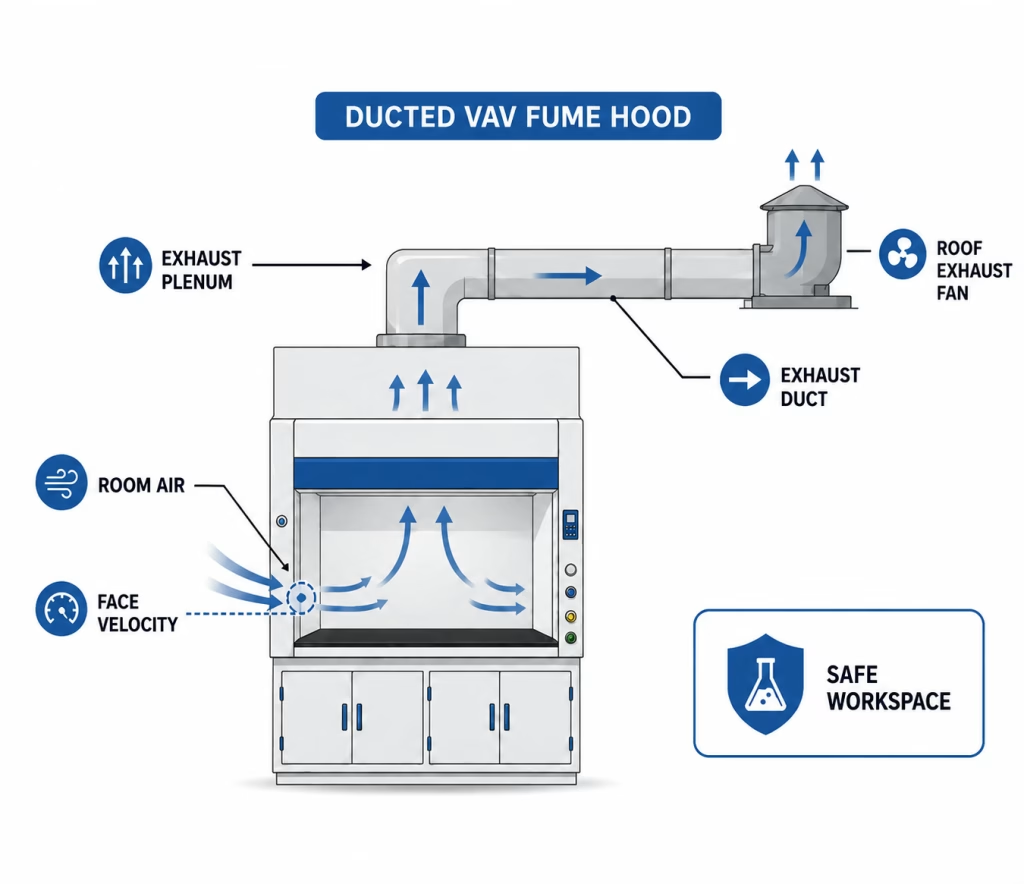
A fume hood works by drawing room air inward through the open sash, sweeping across the work surface, and carrying chemical vapors and aerosols up through the exhaust plenum and out of the building. That inward airflow creates a pressure differential — air always moves toward the hazard, not away from it. Proper ventilation should also be combined with hazardous chemical storage practices to reduce exposure risks throughout the laboratory.
The sash (the movable glass panel at the front) controls the size of the opening. A lower sash position reduces the face area, which concentrates airflow and raises the velocity across the opening. This is why working with the sash raised above the marked safe-working height is one of the most common hood safety violations in US labs. Proper sash discipline alone can prevent a significant share of exposure incidents.
Beyond vapor control, a well-maintained hood also provides a physical barrier against chemical splashes, small fires, and minor overpressure events. The sash glass acts as the last physical shield between the worker and an unexpected reaction. That dual role — airflow containment plus physical protection — is why no amount of PPE substitutes for the hood itself.
A chemical safety and lab ventilation guide covering complementary storage controls is worth reviewing alongside any hood specification.
OSHA, ANSI/AIHA Z9.5, and the standards that mandate fume hood use
OSHA’s Laboratory Standard[2] (29 CFR 1910.1450) requires employers to provide control measures — including fume hoods — whenever an employee’s exposure to a hazardous chemical could exceed the action level or permissible exposure limit. These controls are often part of a broader laboratory safety compliance program that also covers chemical handling, storage, and emergency procedures.
ANSI/AIHA Z9.5[3] is the defining US laboratory ventilation standard. It sets face velocity requirements, specifies alarm systems, and mandates annual performance testing. NFPA 45 adds fire-protection requirements specific to laboratory chemical use, including hood construction materials and exhaust system fire suppression. Labs that work with radioactive materials also fall under NRC requirements[4] governing exhaust filtration and containment.
These aren’t optional guidelines. A university chemistry lab, a pharmaceutical QC lab, and an industrial testing facility each carry different regulatory profiles — but all of them require documented hood performance records.
The 5 Laboratory Fume Hood Types and What Distinguishes Each
1. Ducted constant-air-volume (CAV) fume hoods
A CAV hood moves a fixed volume of air at all times — typically in the range of 1,000–1,500 cfm, a published industry norm for standard bench-height models — regardless of sash position. It’s the most common hood type in older US facilities because it’s mechanically straightforward: a blower, ductwork, and a bypass opening above the sash that maintains constant airflow even when the sash is fully lowered.
The trade-off is energy. That air has to be heated or cooled by the building HVAC before it enters the lab, and the hood exhausts it permanently. Lawrence Berkeley National Laboratory studies on fume hood energy use have consistently identified CAV fume hoods as among the largest single energy loads in research buildings.
⚖️ Trade-off: CAV hoods are the most reliable and lowest-maintenance option, but their fixed exhaust volume makes them the most expensive to operate over a 10–20 year lifecycle.
2. Ducted variable-air-volume (VAV) fume hoods
VAV hoods use a motorized damper and sash-position sensor to adjust airflow continuously. When you lower the sash, the damper closes proportionally — maintaining face velocity within spec while exhausting less total air. Compared to CAV, a VAV system can cut hood energy consumption by 40–60% according to Lawrence Berkeley National Laboratory research[6].
The total installed cost — hood, controls, dampers, and HVAC modifications — runs significantly higher than CAV. Discovering an undersized exhaust system during installation adds weeks to a project timeline and often forces a redesign. VAV makes sense for new construction and major renovations where the mechanical infrastructure can support it; retrofitting it into a 1980s lab building is a different calculation entirely.
3. Ductless recirculating fume hoods
Ductless hoods filter exhaust air through activated carbon or HEPA media and return it to the room — no connection to the building exhaust system required. That makes them appealing for labs without existing ductwork, rented spaces, or locations where a structural penetration is cost-prohibitive.
The word “ductless” does not mean “safe for any chemical.” Each filter cartridge is rated for a specific chemical family, and a filter saturated by one solvent offers no protection against an acid vapor. Labs must maintain strict chemical inventories, replace filter media on schedule, and never use ductless fume hoods for carcinogens, highly toxic compounds, or volatile perchloric acid.
The most common mistake in ductless hood selection isn’t picking the wrong model. It’s not updating the approved chemicals list after the filter is installed.
4. Perchloric acid and other specialty ducted hoods
Specialty fume hoods address hazardous chemicals that standard ducted hoods can’t safely handle.
Perchloric acid hoods are constructed of non-reactive materials — typically stainless steel or polypropylene — and include a built-in water-wash system. Perchloric acid vapors can crystallize in standard ductwork and detonate on contact with organic material. Perchloric acid work demands a dedicated hood and a dedicated exhaust stack. This is non-negotiable regardless of volume or frequency.
Radioisotope hoods feature HEPA exhaust filtration, continuously welded interior corners with no seams that could trap contamination, and construction materials that resist radioactive contamination. They’re designed to allow remote monitoring of exhaust filter integrity.
5. Biological safety cabinets (BSCs)
Biological safety cabinets are often confused with fume hoods, but they serve a different primary function: protecting the work from contamination as much as protecting the worker. A Class II BSC[7] uses HEPA-filtered supply and exhaust air in a specific airflow pattern designed for biohazardous materials. Using a standard fume hood for live biological agents is both a containment failure and an OSHA violation.
Performance Factors That Determine Whether a Hood Actually Protects You
Face velocity targets and ASHRAE 110 containment testing
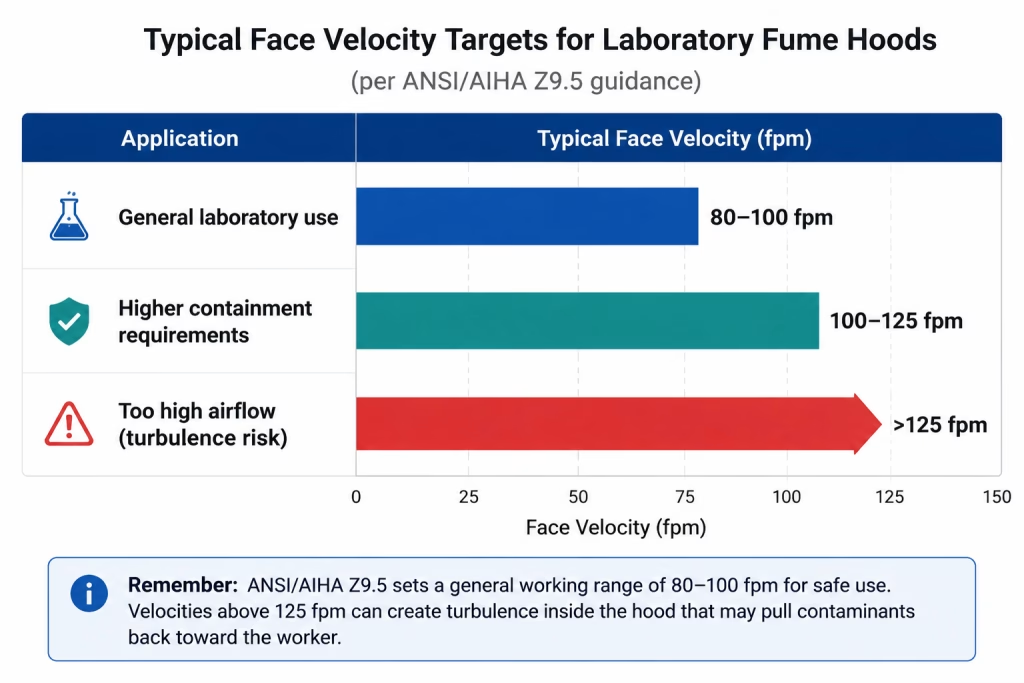
Face velocity — the speed of air moving through the sash opening, measured in feet per minute — is the primary performance metric for any ducted hood. ANSI/AIHA Z9.5[8] sets a general working range of 80–100 fpm for safe use. Going higher isn’t automatically better: velocities above 125 fpm can create turbulence inside the hood that actually pulls contaminants back toward the worker.
ASHRAE Standard 110 provides the standard containment test: a tracer gas (typically sulfur hexafluoride) is released inside the hood at a defined rate, and a sensor placed at the worker’s breathing zone measures leakage. A hood that passes ASHRAE 110 at the “as-manufactured” or “as-installed” condition gives you documented evidence of real containment performance — not just an airflow number.
Sash configurations and their effect on airflow control
Three sash designs cover most laboratory fume hood installations:
- Vertical-sliding sash: the classic single-panel design; easiest to use, provides a full-width physical barrier at any height.
- Horizontal-sliding sash: panels slide side-to-side; limits total open area, which improves velocity at a lower exhaust volume.
- Combination sash: horizontal panels mounted in a vertical frame; captures some energy benefit of horizontal design while maintaining full-width access when needed.
Horizontal and combination sashes are standard on most modern VAV hoods because they constrain the maximum open face area, making it easier to maintain proper face velocity across a wider range of sash positions.
Alarm systems and real-time monitoring requirements
ANSI/AIHA Z9.5 requires a visual or audible alarm that activates when face velocity drops below the minimum set point. A low-flow alarm is not optional — it’s the hood’s only active warning system when containment has been compromised.
Modern VAV installations typically integrate the hood monitor with the building automation system, logging airflow data continuously. That data trail matters: in a regulatory audit or an incident investigation, timestamped airflow records are the difference between demonstrable compliance and liability exposure.
Matching the Right Fume Hood Type to Your Lab Application
Matching hood type to chemical hazard class
The chemicals in use drive the hood selection — not the other way around. A practical decision framework:
- Low-hazard solvents and reagents, small volumes: a ductless recirculating hood with the correct filter cartridge is viable, provided chemicals and quantities stay within the filter’s certification limits.
- Routine organic synthesis, moderate toxicity: a standard ducted CAV or VAV hood at 80–100 fpm, ASHRAE 110 certified.
- Concentrated acids or bases, large-volume work: ducted VAV hood with acid-resistant liner.
- Perchloric acid digestions: a dedicated perchloric acid hood with wash-down system.
- Radioactive isotopes: radioisotope hood with HEPA-filtered exhaust and dedicated stack.
- Biological agents: a Class II BSC, not a fume hood.
Facility constraints: ductwork, HVAC capacity, and renovation limits
A VAV hood with no compatible HVAC infrastructure behind it is just an expensive CAV hood. Before specifying any ducted hood, confirm three things: the available exhaust duct capacity, the HVAC system’s ability to make up the exhausted air (supply air balance), and the structural path for the exhaust stack.
⏱️ Time saver: Request an HVAC capacity assessment from your facilities team before finalizing any hood specification — discovering an undersized exhaust system during installation adds weeks to a project timeline and often forces a redesign.
Ductless hoods eliminate the infrastructure problem but impose strict restrictions on which chemicals can be used safely. For a rented lab space or a temporary installation, that trade may be worth making — but only after a formal chemical hazard review confirms the filter is rated for every compound in active use.
Energy costs and long-term total cost of ownership
Energy cost is the single largest line item in a fume hood’s total cost of ownership over a 10–15 year period, often exceeding the initial purchase price.

A ductless hood’s near-zero energy cost looks compelling until filter replacement costs are factored in. A high-use ductless hood may require cartridge replacement every 3–6 months; cartridge sets vary widely in price depending on filter type, chemical class, and supplier — budget this as a recurring line item, not a one-time cost, and get a vendor quote specific to your chemical profile before committing.
Frequently Asked Questions: Fume Hoods
How often must fume hoods be tested?
ANSI/AIHA Z9.5 requires that laboratory fume hoods be performance-tested at least annually. The minimum test is a face velocity measurement across multiple sash positions. Many institutions also require an ASHRAE 110 tracer gas containment test at installation (“as-installed” condition) and after any significant repair or ductwork change. If a hood is moved, modified, or returns from service after a facility shutdown, treat it as a new installation for testing purposes.
Documented test records are not just a best practice — under OSHA 29 CFR 1910.1450, they are part of the required Chemical Hygiene Plan.
Can I use a fume hood as a biosafety cabinet?
No. Standard ducted fume hoods and biosafety cabinets are engineered for different hazard profiles. A fume hood protects the worker from chemical exposure by drawing air inward and exhausting it out of the building. A Class II biosafety cabinet also protects the sample from environmental contamination and, in Type B2 configurations, exhausts 100% of air to the outside.
Using a chemical fume hood for work with live bacteria, viruses, or other biological agents provides no HEPA filtration of the exhaust, no protection of the sample, and likely violates both OSHA’s Bloodborne Pathogens Standard and CDC/NIH biosafety guidelines. The two pieces of equipment are not interchangeable.
What face velocity is required for safe fume hood operation?
ANSI/AIHA Z9.5 specifies 80–100 fpm as the general working range for safe use of ducted fume hoods. Higher is not better: velocities above approximately 125 fpm generate turbulence at the sash face that can carry contaminants out of the hood rather than containing them.
The correct approach is to verify face velocity with a calibrated anemometer at multiple sash positions and then confirm actual containment with an ASHRAE 110 tracer gas test. Proper face velocity, measured and documented, is the foundation of a defensible hood safety program.
Are ductless fume hoods safe for all chemicals?
No — and this is the most consequential misunderstanding in ductless hood procurement. Each activated carbon filter cartridge is certified for a defined family of chemicals at defined concentration ranges. A cartridge rated for aromatic hydrocarbons offers no meaningful protection against inorganic acid vapors such as hydrochloric or sulfuric acid.
Carcinogens, acutely toxic compounds (IDLH below 10 ppm), and radioactive materials are not appropriate for ductless hoods under any filter configuration. Before approving ductless fume hoods for any application, the institution’s chemical hygiene officer should review the complete list of chemicals against the filter manufacturer’s certified chemical compatibility data — and that review should be repeated whenever the chemicals in use change.
Sources
[1] ANSI/ASSP Z9.5-2022: Laboratory Ventilation — blog.ansi.org
[2] 1910.1450 – Occupational exposure to hazardous … — osha.gov
[3] Quick Guide to ANSI/ASSP Z9.5-2022: Laboratory Ventilation — tsi.com
[4] 10 CFR Part 20 — Standards for Protection Against Radiation — ecfr.gov
[5] Energy Use and Savings Potential for Laboratory Fume Hoods — eta-publications.lbl.gov
[6] SHUT THE SASH: FUME HOOD VENTILATION IN … — cec.ucdavis.edu
[7] Biosafety Cabinetry Certification: NSF/ANSI 49 — nsf.org
[8] Laboratory Guidelines and Standards — greenlabs.caltech.edu


