

Picking the right RFID reagent cabinet isn’t a catalog exercise — it’s a compliance and safety decision. The wrong choice leaves reagent inventory unaccounted for, exposes your lab to OSHA hazardous storage violations[1], and turns every audit into a scramble. The right cabinet, paired with the right RFID technology, converts those risks into a documented, automated record before an inspector ever arrives.

The 5-Step RFID Reagent Cabinet Checklist
- Step 1: Understand what RFID technology does inside a reagent cabinet
- Step 2: Match tag type to your reagent containers and environment
- Step 3: Select the correct RFID readers and antenna configuration
- Step 4: Confirm the cabinet meets your safety and compliance standard
- Step 5: Validate the management system integration before you buy
Expected outcome: a fully compliant, automated reagent tracking setup — typically configurable in one to two days once hardware arrives.
3 Critical Prerequisites Before Evaluating Any RFID Reagent Cabinet
Before you touch a spec sheet, confirm three things are in place:
- A reagent inventory baseline — a current list of every chemical, its container size, and its chemical classification (flammable, corrosive, cryogenic, etc.)
- Your applicable compliance standard — NFPA 45[2] for flammable storage, or 2 CFR Part 200 if you receive federal R&D funding. For a broader overview of cabinet compliance requirements, see our safety storage cabinet regulations and standards.
- Your IT environment — whether you run an existing LIMS or ERP system the cabinet data needs to feed
A common delay reported by lab integrators is hardware arriving before IT has confirmed the integration path. Confirm your network topology, authentication requirements, and LIMS API availability in writing before issuing a purchase order.
UHF RFID operates between 860–960 MHz in the U.S. per FCC Part 15[3], so confirming your facility has no restricted-band conflicts is worth a 15-minute check before procurement.
Step 1: What RFID Technology Actually Does Inside a Reagent Cabinet
Why this matters: Most labs treat RFID as fancy barcodes. It isn’t. Unlike barcodes, passive RFID tags don’t need line-of-sight — the RFID reader interrogates every tag in the cabinet simultaneously, giving you a real-time snapshot of what’s inside without opening the door.
The Core Architecture of a Laboratory RFID Solution
An RFID reagent cabinet uses embedded readers and antennas mounted inside the cabinet walls to continuously ping passive RFID tags attached to each reagent container. Every time a bottle enters or leaves, the system logs it — timestamped, user-linked via door badge, and synced to your inventory database.
The two tag architectures you’ll encounter:
| Tag Type | Read Range | Best For | Metal Interference |
|---|---|---|---|
| HF (13.56 MHz) | 1–10 cm | Small vials, high density | Low |
| UHF RFID (860–960 MHz) | Up to 1 m | Large bottles, bulk storage | Requires on-metal tag |
| Passive RFID (UHF) | 0.5–3 m | General lab use | Use specialized labels |
| Active RFID | 10–100 m | Warehouse-scale asset tracking | Minimal |
For a reagent cabinet specifically, UHF RFID with on-metal passive tags is the standard choice. HF works well for dense small-vial configurations like cryogenic sample racks.
Common mistake: Ordering standard passive RFID labels designed for cardboard and sticking them on metal reagent containers. Metal detuning can cut read range by 80% or eliminate it entirely. Specify on-metal RFID labels — built with a foam or air-gap spacer that preserves antenna performance.
Step 2: Match the RFID Tag to Your Containers and Storage Environment
Why this matters: A tag that fails in your cabinet’s environment means phantom inventory — the system thinks a reagent is present when it isn’t, or vice versa. In a forensic laboratory or a pharmaceutical setting, that’s a chain-of-custody failure.
Three environmental variables determine your tag spec:
- Temperature range — standard lab RFID labels are rated to roughly -40°F to 257°F. Cryogenic storage (liquid nitrogen tanks reach -320°F) requires cryogenic-rated RFID tags with flexible inlays.
- Chemical exposure — polyester-laminated labels resist most solvents; for aggressive acids, specify PTFE-coated or ceramic-substrate tags.
- Container material — glass, HDPE, and metal each interact differently with RF. Test a sample of 10–20 tagged containers in your actual cabinet before committing to a full rollout.
⏱️ Time saver: Cryogenic RFID labels typically cost 3–5× more per tag than standard passive RFID labels — the exact delta varies by supplier and order volume. For a 200-sample cryogenic inventory that difference adds up, but it’s far cheaper than a single regulatory incident from a missed sample.
Common mistake: Using the same tag spec across the whole lab because procurement wants a single SKU. A cabinet storing corrosives and a cabinet storing flammables have different environmental demands. Buy two tag specs if the environments diverge.
Step 3: Proven RFID Reader and Antenna Configuration for Reagent Cabinets
Why this matters: An underpowered reader misses tags; an over-powered one reads neighboring cabinets and creates false inventory entries.
Fixed Reader Configuration for Automated Inventory Logging
Fixed RFID readers mounted inside the cabinet door panel are the standard configuration for reagent cabinets. A single 4-port UHF RFID reader can drive four internal antennas — typically one per shelf — giving full shelf-level location data, not just “it’s in the cabinet somewhere.”
Here’s the counterintuitive part: adding more antenna ports doesn’t automatically improve read accuracy. Past four antennas in a standard 36-inch cabinet, overlapping RF fields can create null zones that actually reduce read rates below what a two-antenna layout achieves. Validate any configuration with a controlled tag-density test before deployment.
Key reader specs to confirm:
- Read rate: vendor-documented at maximum cabinet capacity; ask for this figure in writing, as published specs vary significantly by tag density and container material
- Port count: 4-port minimum for a 4-shelf cabinet; 8-port for double-wide units
- Protocol: EPC Gen2 / ISO 18000-6C[4] is the U.S. default — confirm any reader you evaluate is Gen2 compliant
- Environment rating: IP54 or better if the cabinet handles liquid reagents with splash risk
Handheld RFID Readers for Lab Cycle Counts and Exceptions
Fixed readers handle automated logging. Handheld RFID readers handle the exceptions — cycle counts, receiving checks, and locating a specific reagent when your inventory system says “cabinet 3” but the technician can’t find it.
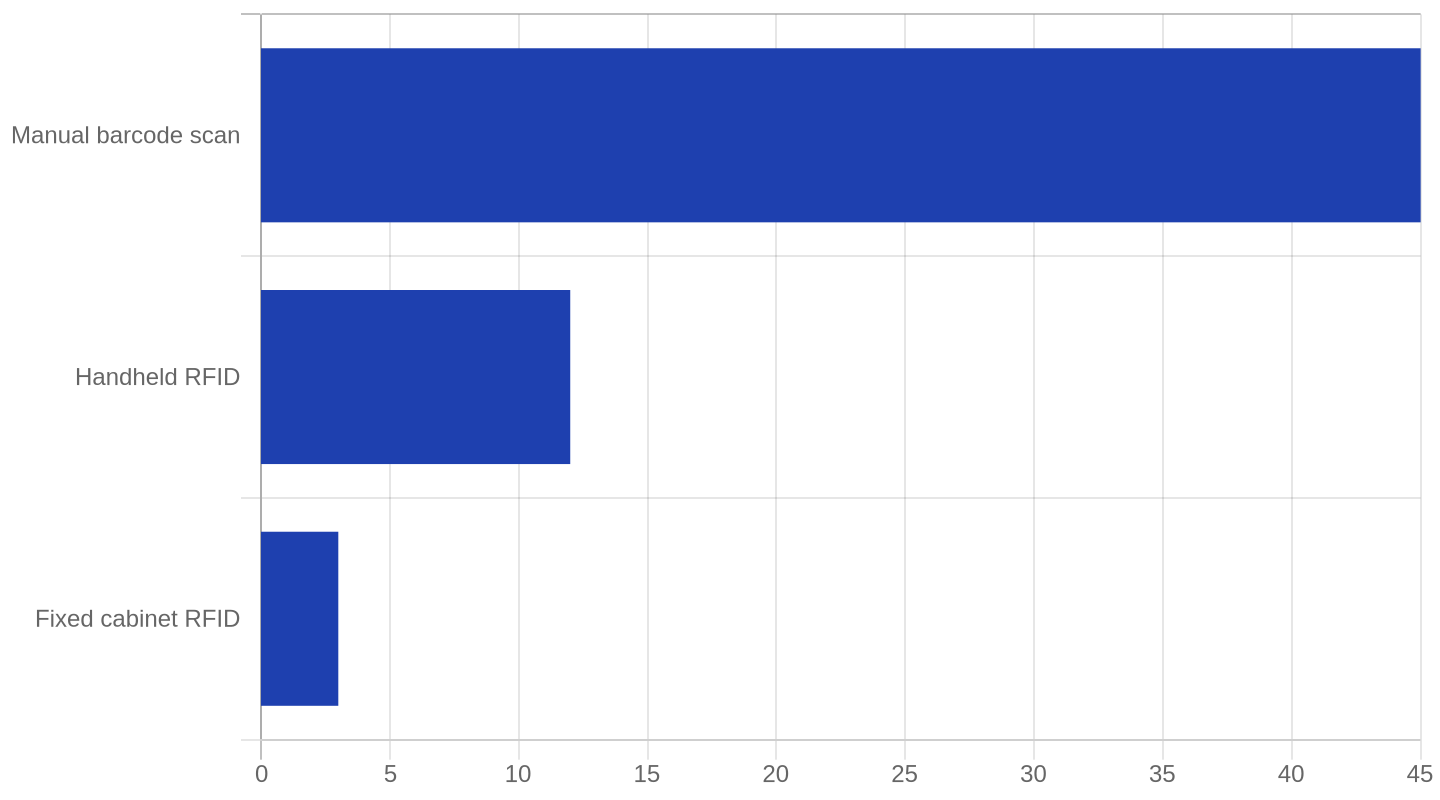
A good handheld reader for lab use weighs under 1 lb, reads Gen2 passive tags at 1–3 m, and integrates with your LIMS via Bluetooth or Wi-Fi. Doing a physical equipment tracking sweep of a fully stocked cabinet takes under 10 minutes without touching a keyboard. That’s a concrete workflow change from barcode-based processes, where the same sweep requires line-of-sight scanning of every individual container.
Common mistake: Buying a warehouse-grade handheld reader for lab use. Those units are built for pallet-level read distances and are too powerful for cabinet-level precision — they’ll read through walls and pull in tags from adjacent storage.
⏱️ Time saver: When evaluating any RFID solution, run a tag-density test at maximum realistic capacity — not the vendor’s demo with 20 bottles in a cabinet rated for 150. Read rate claims made at low fill levels don’t predict performance under real lab conditions.
Step 4: Safety Certifications and Compliance Standards Every RFID Reagent Cabinet Must Meet
Why this matters: An RFID-enabled cabinet that doesn’t meet fire and chemical storage codes gives you inventory visibility and a compliance violation at the same time.
Required Safety Certifications by Reagent Class
For flammable reagents, the cabinet itself must meet FM Approvals Class 6050[5] — a standard that sets performance and construction requirements for storage cabinets used with ignitable (flammable or combustible) liquids — or the equivalent NFPA 45 listing. When specifying a cabinet for these reagents, review the flammable storage cabinet selection requirements before choosing the RFID hardware configuration. Huanawell’s flammable safety cabinets are built to OSHA and NFPA standards and have been tested by a third-party testing body; confirm the specific accreditation documentation with the manufacturer and verify it is acceptable to your local authority having jurisdiction before purchase.
Minimum hardware checklist by reagent class:
| Reagent Class | Cabinet Requirement | RFID Consideration |
|---|---|---|
| Flammable liquids | FM Class 6050 or NFPA 45 listed | Use intrinsically safe reader if Class I Div 1 area |
| Corrosive acids | Polypropylene or epoxy-coated interior | PTFE-coated RFID labels |
| Cryogenic samples | Insulated, vented | Cryogenic-rated passive RFID tags |
| Controlled substances | DEA-compliant lock + audit log | RFID + biometric access integration |
2 CFR Part 200 Compliance: How an RFID Reagent Cabinet Supports Federal Equipment Tracking
Federal labs operating under 2 CFR Part 200[6] must track every equipment item purchased with federal funds, maintain a physical inventory every two years, and produce asset records on demand.
A fixed RFID reader logs every reagent and equipment item movement automatically. It creates a timestamped, user-attributed audit trail. That trail satisfies the Part 200 physical inventory requirement without a manual count. The key is confirming your management system exports data in a format your grants office accepts — typically CSV or direct API integration with systems like Kuali Research or Grants.gov-linked ERP platforms.
Common mistake: Assuming the RFID cabinet’s built-in software generates Part 200-compliant reports. Most don’t out of the box. Ask vendors for a sample report and have your compliance officer review it before signing a purchase order.
Step 5: Validate the RFID Management System Before You Commit
Why this matters: The management system — the software layer that turns RFID data into actionable inventory intelligence — is where most RFID solutions for lab equipment tracking fall short, not the hardware.
What a Properly Configured RFID Solution for Reagent Cabinets Should Deliver
A properly configured RFID solution for a reagent cabinet should deliver:
- Real-time inventory counts updated within seconds of a door close event
- Expiration date alerts — the system reads the tag, cross-references the reagent database, and flags anything within 30 days of expiry
- Chain-of-custody logs — every access event tied to a user badge or biometric, exportable for audit
- Low-stock thresholds that trigger automated purchase requests without a human running a count
- Equipment tracking integration — linking reagent usage data to the instruments that consume them, so calibration and maintenance schedules run on usage cycles rather than arbitrary calendar intervals
Biopharmaceutical RFID Reagent Cabinet Requirements: 21 CFR Part 211 Lot Traceability
In biopharmaceutical labs, reagent traceability isn’t optional — it’s a 21 CFR Part 211[7] requirement. Every reagent used in a production batch must be traceable to its lot number, the storage conditions it experienced, and the technician who accessed it.
That means a compliant audit record needs to capture specific data fields: container ID, storage temperature log at time of access, user ID tied to a validated access credential, date and time stamp for every access event, and a lot number cross-reference linking the physical container to the batch record.
Manual transcription of those fields introduces transcription errors and creates data integrity risk — exactly what FDA 21 CFR Part 11[7] electronic records requirements are designed to prevent.
A proven configuration is a fixed RFID reader inside the cabinet, UHF passive RFID tags on each container, and a management system with a validated API connection to the existing LIMS.
When the LIMS is API-capable, the data chain from physical access to batch record entry is automatic — no manual transcription, no lag, no opportunity for a technician to skip the log entry at the end of a long shift. For legacy systems requiring flat-file exports, integration is slower and requires a defined file-transfer schedule, but the data fields remain the same.
Either way, the management system must be configured to capture all five data elements above, not just container presence.
For samples specifically, the tag-to-LIMS chain also enables retroactive queries: if a lot is recalled, the system can pull every access event, every user, and every downstream instrument that consumed reagent from that lot — in seconds rather than days of manual record review.
5 Questions to Ask Every RFID Vendor — and What Good Answers Look Like
Before finalizing any RFID solution, get written answers to these five questions from every vendor:
What is the tag read rate at maximum cabinet capacity (e.g., 150 bottles, mixed glass and plastic)? A credible vendor provides a documented test result at realistic fill levels, not a spec-sheet maximum measured with 20 tags in open air. If the answer is “our system achieves 99.9% accuracy” with no test conditions attached, that’s a red flag.
Does the reader carry FCC Part 15 certification for the U.S. market? A compliant vendor produces an FCC ID number immediately. If they say “we believe it’s compliant” or point to a foreign certification only, treat that as a disqualifier in a regulated environment — operating an uncertified reader is a federal violation, not just a procurement risk.
What is the warranty and mean time between failures for the fixed RFID reader? Look for MTBF data from the reader manufacturer, not a general “one-year warranty” statement. Cabinet-mounted readers operate continuously; failure means an inventory gap. Published MTBF figures for fixed UHF readers vary considerably by manufacturer and model; request the specific figure for the model you are evaluating, verify it against the manufacturer’s published datasheet, and confirm it meets your uptime requirements with your local authority or facilities team[8].
Does the management system have a documented API for LIMS integration? A documented API means published endpoints, authentication methods, and error-handling behavior. A vendor who says “we can do custom integration” without published API documentation is describing a one-off development project, not a product — budget and timeline risk increase substantially.
Can the system generate a 2 CFR Part 200-compliant inventory report or a 21 CFR Part 211 lot-traceability record? Ask for a sample report in the exact format your compliance officer will review. A vendor who produces one in under 10 minutes during a sales call has built this for regulated labs. One who needs to “check with engineering” hasn’t.
RFID Reagent Cabinet Quick-Reference: Key Specifications
| Decision point | What to confirm |
|---|---|
| Tag type | UHF passive RFID with on-metal labels for metal containers |
| Cryogenic storage | Cryogenic-rated flexible inlay tags, rated below -300°F |
| Reader spec | EPC Gen2 / ISO 18000-6C compliant, ≥4 antenna ports |
| Antenna layout | Validate null-zone risk beyond 4 antennas in standard 36-inch cabinets |
| Flammable cabinet standard | FM Class 6050 or NFPA 45 listed, tested by accredited third party |
| Federal lab compliance | 2 CFR Part 200 audit-trail export capability |
| Pharma compliance | 21 CFR Part 211: container ID, temp log, user ID, timestamp, lot number |
| Management system must-have | LIMS API integration + automated expiration alerts |
3 Common RFID Read Failures and How to Fix Them
Problem 1: Missed reads on metal containers
Cause: Standard passive RFID labels detuned by metal surface.
Fix: Replace with on-metal UHF RFID labels (foam spacer construction). Re-test with a handheld RFID reader in survey mode to confirm read rate above 95%.
Problem 2: Adjacent cabinet cross-reads
Cause: Reader power set too high; antenna pattern bleeding through cabinet walls.
Fix: Reduce reader TX power in 1 dBm steps until cross-reads stop. Most lab RFID readers allow per-port power adjustment; target the minimum power that still achieves 99%+ read rate inside the cabinet.
Problem 3: Management system shows inventory lag
Cause: Cabinet door sensor isn’t triggering a re-read cycle on close.
Fix: Confirm the door sensor is wired to the reader’s trigger input, not just the logging software. The reader should fire a full inventory cycle within 2 seconds of door close — check the reader’s event log to confirm the trigger is firing.
Request a Compliance-Matched Demo Before You Order
Once you’ve mapped your reagent classes, confirmed your compliance standards, and outlined your LIMS integration requirements, request a configured demo — not a feature walkthrough. Ask the vendor to read 50 tagged containers in a closed cabinet and show you the management system report, end to end, in under 5 minutes.
If they can’t demonstrate that in a sales call, the production system won’t do it in your lab.
The specification work described in these five steps takes a few hours. Done correctly, it eliminates the most common sources of post-installation rework: wrong tag spec, underpowered reader, and a management system that can’t produce the compliance report your auditor actually needs. The technology is reliable when it’s matched to the environment. The matching is the work.
Have a project or a spec sheet in hand? Talk to huanawell.com — real engineers answer.
Frequently asked questions
How do I choose the right RFID tag?
Choose an RFID tag rated for your cabinet’s environment first. For reagent cabinets, select chemical-resistant UHF tags that tolerate solvent vapors, temperature swings, and humidity. Passive UHF tags in the 860–960 MHz range work well for most lab shelving because they read through plastic containers at practical distances. Confirm the tag’s adhesive or housing bonds to glass, HDPE, and metal surfaces. Match read range to your cabinet depth so every item registers without manual repositioning during scans.
How to use RFID for inventory?
Attach an RFID tag to each reagent container when it enters the lab, then configure your cabinet’s built-in reader to log every item placed in or removed from storage. The system timestamps movements and syncs quantity data to your lab information management system or a cloud dashboard. Set automated low-stock and expiration alerts so reorders happen before a shortage occurs. Run scheduled audits by scanning the cabinet interior and comparing the result against your expected inventory list to flag discrepancies instantly.
What is RFID used for in healthcare?
In United States healthcare and clinical laboratory settings, RFID tracks controlled substances, biological samples, and hazardous reagents to maintain chain-of-custody records required by DEA and OSHA regulations. Hospitals use cabinet-level RFID to monitor medication dispensing, reduce diversion, and cut manual counting time. Clinical labs apply the same technology to reagent cabinets to enforce FIFO usage, document cold-chain compliance, and generate audit-ready logs without manual data entry, directly supporting CAP and Joint Commission inspection readiness.
Sources
[1] 1910.1450 – Occupational exposure to hazardous … — osha.gov
[2] NFPA 45 Standard Development — nfpa.org
[3] 47 CFR Part 15 Subpart B — Unintentional Radiators — ecfr.gov
[4] ISO/IEC 18000-6:2010 – Information technology — iso.org
[5] FM 6050 Standard For Storage Cabinets — kewaunee.in
[6] 2 CFR Part 200 — Uniform Administrative Requirements … — ecfr.gov
[7] Current Good Manufacturing Practice (CGMP) Regulations — fda.gov
[8] FX9600 Fixed RFID Reader — barcodefactory.com


