

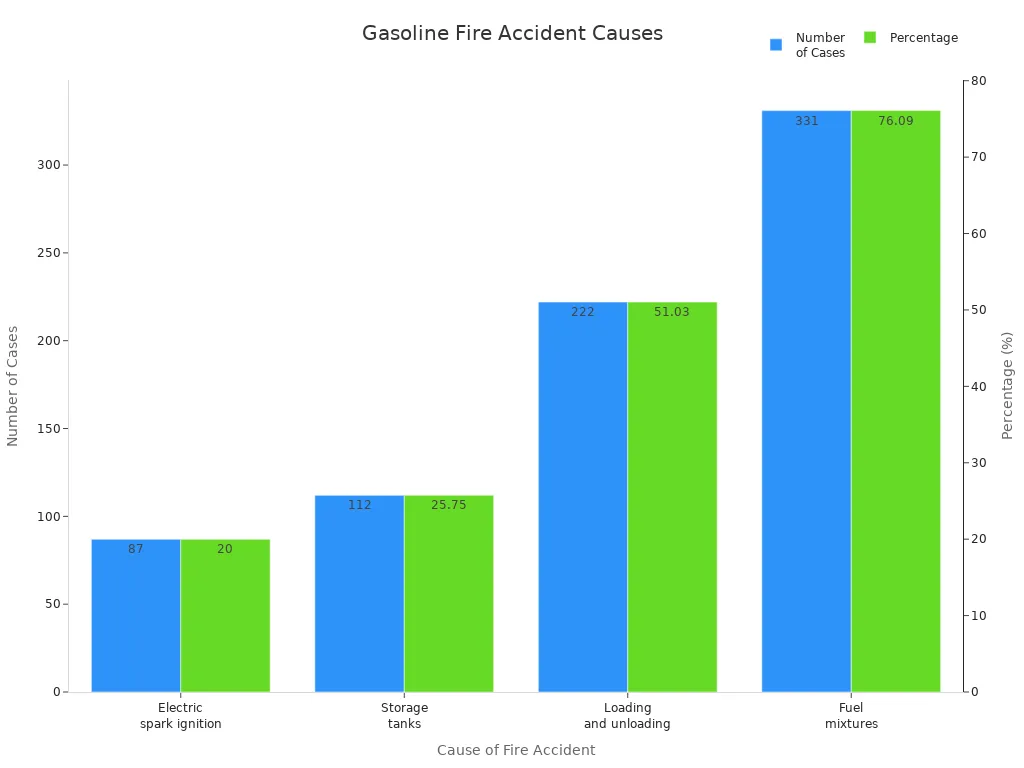
You can store gasoline safely with Gasoline Storage Cabinets: Specialized Solutions for Safe Fuel Storage. These cabinets protect you from fire accidents and keep your fuel secure. Many accidents happen because people do not use proper storage. The chart below shows how often fire accidents occur when handling gasoline:
You lower your risk and gain peace of mind when you choose the right cabinet.
Gasoline Storage Cabinets: Specialized Solutions for Safe Fuel Storage

What Are Gasoline Storage Cabinets?
You use Gasoline Storage Cabinets: Specialized Solutions for Safe Fuel Storage to keep gasoline safe and secure. These cabinets protect you from fire and spills. Manufacturers build them with strong steel and special features that help prevent accidents. You can find cabinets in bright colors like red or yellow, which warn you about the dangerous contents inside. Many cabinets have adjustable shelves, leakproof doors, and locking systems. You can see the main features in the table below:
| Feature | Description |
|---|---|
| Strong Steel | Made from 18-gauge steel for fire resistance and strength. |
| Finished in a Warning Color | Red or yellow signals caution. |
| Heavy Duty | Supports heavy weight with sturdy shelves. |
| Adjustable Shelves | Lets you organize gasoline containers safely. |
| Grounding Attachment | Reduces static electricity and fire risk. |
| Meets OSHA Requirements | Follows workplace safety rules. |
| Meets NFPA Fire Codes | Adds extra fire protection. |
| FM Standard | Shows high safety standards. |
| Leakproof Door | Stops spills from escaping. |
| Locking Doors | Keeps gasoline secure and controls access. |
Why Specialized Cabinets Are Needed
You face many hazards when you store gasoline without proper cabinets. Gasoline Storage Cabinets: Specialized Solutions for Safe Fuel Storage help you avoid these dangers. Gas vapors can ignite from appliances, static electricity, or pilot lights. Accidents often happen when you transfer gasoline or use it in small spaces. Storing gasoline in places without ventilation lets flammable vapors build up, which increases the risk of fire. Flammable vapors are heavier than air and settle at ground level, making them easy to ignite. You should use specialized cabinets if you store more than 25 gallons of gasoline. These cabinets keep your fuel safe and lower the chance of accidents.
Tip: Always check your cabinet for leaks and keep it locked to protect your family and property.
Key Safety Features of Gasoline Storage Cabinets: Specialized Solutions for Safe Fuel Storage

Fire-Resistant Materials and Construction
You protect your gasoline best when you choose cabinets built with fire-resistant materials. Gasoline Storage Cabinets: Specialized Solutions for Safe Fuel Storage use thick steel plating and fireproof layers. These cabinets can withstand fire for up to 90 minutes. You get automatic closures that seal the cabinet if a fire starts. Self-sealing vents close during a fire to keep vapors inside. Retention basins hold leaks and prevent spills from spreading. You also find grounding conductors that stop static electricity and explosions. The table below shows how these features compare to standard storage solutions:
| Feature | Fire-Resistant Cabinets | Standard Storage Solutions |
|---|---|---|
| Fire Resistance | Certified for 90 minutes of fire resistance | No specific fire resistance |
| Automatic Closures | Hydraulic door closure that seals automatically | Manual closures, no automatic seal |
| Self-Sealing Vents | Vents that close during a fire | No such feature |
| Retention Basin | Must hold at least 10% of total volume | No retention for leaks |
| Material | Thick steel plating with fireproof layers | Varies, often not fireproof |
| Grounding Conductor | Included to prevent static and explosions | Typically absent |
| Locking Mechanism | Three-point handle locking system | Standard locks, less secure |
You lower your risk of fire and spills when you use cabinets with these features. You keep your fuel safe and your property protected.
Ventilation and Vapor Control
You need proper ventilation to keep gasoline vapors from building up. Gasoline Storage Cabinets: Specialized Solutions for Safe Fuel Storage include advanced vapor control systems. These systems help you avoid explosions and health risks. You find special technologies in these cabinets:
- The Safe-T-Vent™ Thermally-Actuated Safety Cabinet Vent Damper keeps the cabinet safe during a fire.
- A fusible link melts at 165°F (73.9°C) and closes the damper to stop air flow.
- Mechanical ventilation systems prevent flammable vapors from collecting.
You benefit from active vapor recovery methods that regulate vapor pressure. You get consistent performance even when you use electric-only equipment.
“The proposed active vapor recovery method effectively regulates fuel tank vapor pressure under electric-only operating conditions, achieving consistent and repeatable vapor control performance. Compared to traditional passive onboard refueling vapor recovery systems, the active method shows clear advantages, particularly in long-term electric-only driving scenarios. Experimental results indicate that stable vapor pressure regulation can be achieved without engine operation, addressing limitations of conventional systems.”
You protect yourself and others from dangerous fumes when you use cabinets with these ventilation features.
Secure Locks and Clear Labels
You keep gasoline secure when you use cabinets with strong locks. Gasoline Storage Cabinets: Specialized Solutions for Safe Fuel Storage often have three-point handle locking systems. You control who can access the fuel. You also find clear labels on the cabinet. These labels warn you and others about the flammable contents. You see bright colors like red or yellow that signal danger. You avoid accidents by making sure everyone knows what is inside. You protect your family, coworkers, and property with secure locks and clear labels.
Choosing Gasoline Storage Cabinets: Specialized Solutions for Safe Fuel Storage
Size and Capacity Options
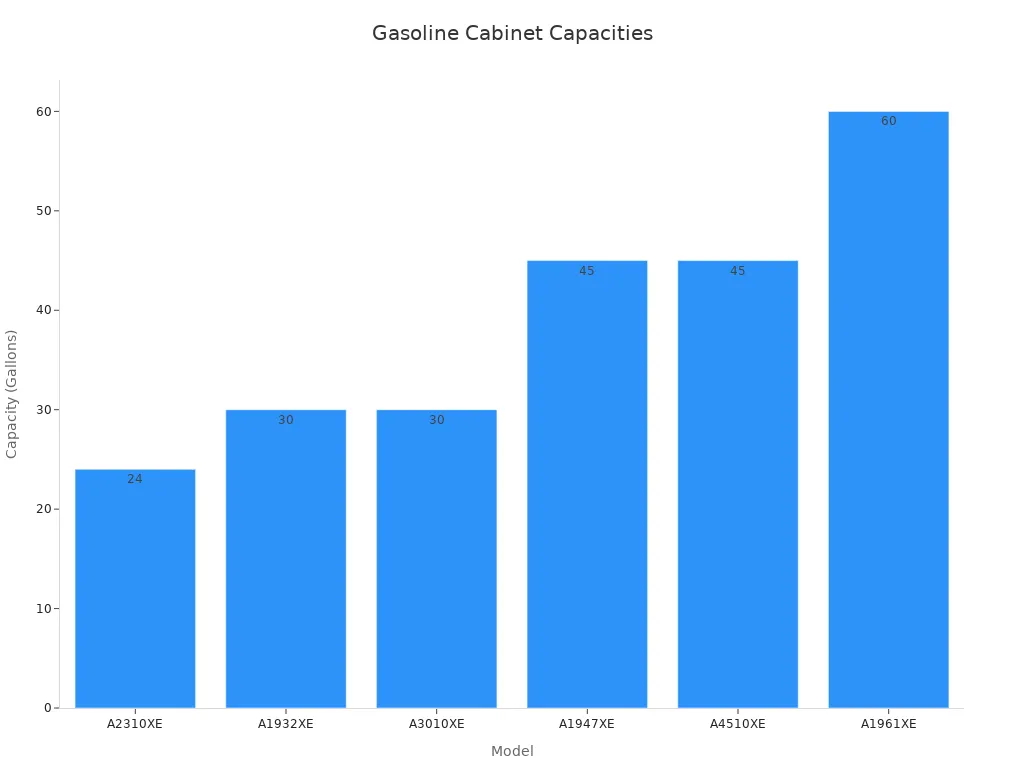
You need to choose the right size when you buy a gasoline storage cabinet. The size depends on how much gasoline you plan to store and where you want to use the cabinet. Most cabinets in the United States come in sizes from 24 gallons to 60 gallons. You should not pick a cabinet larger than 45 gallons for most uses. This size helps you stay within safety guidelines and makes handling easier.
Here are some common cabinet models and their features:
| Model | Capacity | Dimensions (o/s) | Door Specs | Shelves | Weight |
|---|---|---|---|---|---|
| A2310XE | 24 Gal | 23″ x 18″ x 65″ | Self-Closing – 1 | 3 | 270 lbs |
| A1932XE | 30 Gal | 43″ x 18″ x 44″ | Manual – 2 | 1 | 247 lbs |
| A3010XE | 30 Gal | 43″ x 18″ x 44″ | Self-Closing – 2 | 1 | 257 lbs |
| A1947XE | 45 Gal | 43″ x 18″ x 65″ | Manual – 2 | 2 | 342 lbs |
| A4510XE | 45 Gal | 43″ x 18″ x 65″ | Self-Closing – 2 | 2 | 353 lbs |
| A1961XE | 60 Gal | 31″ x 31″ x 65″ | Manual – 1 | 2 | 354 lbs |
You should assess your needs before you choose a cabinet. For example, in a biomedical lab, you need about 10 gallons per double-sided bench. In a physical science lab, you need about 20 gallons per double-sided bench. Always match the cabinet size to your storage needs and space.
Tip: Never use old containers like milk jugs or glass jars for gasoline. Always use cabinets and containers made for fuel storage.
Compliance with Safety Standards (NFPA, OSHA)
You must follow safety standards when you store gasoline. The National Fire Protection Association (NFPA) and the Occupational Safety and Health Administration (OSHA) set rules for safe storage. These rules help you prevent fires and accidents.
Here are the main requirements:
| Standard | Requirement |
|---|---|
| NFPA 30 | Store all flammable liquids in closed containers when not in use. |
| NFPA 30 | Cabinets must keep the inside temperature below 325°F during a fire. |
| OSHA | Cabinets must use 18-gauge steel and have a three-latch door. |
| NFPA 30 | The door sill must be at least two inches high to hold spills. |
| NFPA 30 | Cabinets must have clear signs like “FLAMMABLE” and “KEEP FIRE AWAY”. |
Following these standards keeps you safe. Cabinets that meet OSHA and NFPA rules have better safety records. They lower the risk of fire and make sure you handle gasoline the right way.
- Compliance with OSHA and NFPA standards is essential for safe storage of gasoline.
- These standards cover how cabinets are built, labeled, and how much you can store.
- When you follow these rules, you reduce accidents and keep your property safe.
Tips for Home, Garage, or Business Use
You can use gasoline storage cabinets in many places, such as homes, garages, and businesses. Here are some important tips to help you use them safely:
- Store gasoline only in approved containers and cabinets.
- Keep gasoline away from heat, sparks, and open flames.
- Do not store gasoline inside your home or basement. Use a garage or a detached building.
- Place cabinets in cool, well-ventilated areas. Avoid direct sunlight.
- Always put gas cans on the ground when filling them at a gas station.
- Make sure the storage area is away from electric appliances or ignition sources.
- Check local rules for storage limits and follow them.
- Never use old or repurposed containers for gasoline.
Note: The best place for a gasoline storage cabinet is a detached garage or barn. This keeps dangerous vapors away from your living space.
You protect yourself, your family, and your coworkers when you follow these tips. Gasoline Storage Cabinets: Specialized Solutions for Safe Fuel Storage give you the tools you need to store fuel safely and easily.
Using Gasoline Storage Cabinets: Specialized Solutions for Safe Fuel Storage
Placement and Installation
You improve safety when you place your cabinet in the right spot. Keep at least three meters between the cabinet and any ignition sources like welding areas, electrical panels, or open flames. Avoid placing cabinets in corridors or in front of doorways. This ensures clear escape routes during emergencies. Ground the cabinet to prevent static electricity buildup. Sealed vent bungs help maintain the cabinet’s fire rating unless you install a proper ventilation system. Use clear labeling and signage to warn others about hazards.
A tragic incident in Belgium’s chemical industry, where improper storage caused a €12.5 million loss and a three-month shutdown, shows why correct placement and installation matter.
Checklist for Placement:
- Keep cabinets away from panel boards and electrical outlets.
- Do not allow welding or grinding near cabinets.
- Avoid placing cabinets in exit paths or under stairways.
Loading and Unloading Gasoline
You must follow safe procedures when loading and unloading gasoline. Start with a pre-operation safety inspection. Use truck grounding systems to prevent static electricity. Wear personal protective equipment like gloves and goggles. Position fuel tank trailers properly. Begin loading slowly to prevent static buildup. Monitor the unloading process closely. Follow post-unloading steps to check for leaks or spills.
Common Accident Prevention:
- Install high-level alarms and automatic shutoff valves to prevent overfilling.
- Use physical barriers and dry break couplings to stop drive-away incidents.
- Train operators and inspect loading gantries regularly.
Routine Maintenance and Inspection
You keep your cabinet safe by performing regular maintenance. Inspect for corrosion, cracks, or loose fittings. Test for water buildup at the tank bottom. Schedule professional inspections to meet safety regulations. Check dispensing equipment to prevent leaks. Clean tanks periodically to remove sludge and sediment. Change fuel filters often for clean fuel delivery.
Inspection Schedule Table:
| Inspection Type | Frequency |
|---|---|
| Routine In-Service | Every month |
| External Inspection | Every 5 years |
| Internal Inspection | Every 10 years |
Familiarize yourself with safety standards. Establish a regular inspection schedule. Inspect door seals and latches. Make sure ventilation openings stay clear.
Gasoline Storage Cabinets: Specialized Solutions for Safe Fuel Storage help you protect your property and keep everyone safe when you follow these steps.
Avoiding Common Mistakes with Gasoline Storage Cabinets: Specialized Solutions for Safe Fuel Storage
Overfilling Cabinets
You might think filling your cabinet to the top saves space, but overfilling creates serious risks. Gasoline expands and releases vapors, especially in warm conditions. When you overfill, you leave no room for this expansion. Vapors can escape, causing dangerous fumes or even leaks. These fumes can harm your health and increase the risk of fire.
The 2009 Puerto Rico Terminal explosion was caused by overfilling gasoline storage tanks, leading to a significant vapor cloud that ignited. The investigation revealed operational and regulatory deficiencies, recommending that facilities implement multiple layers of protection, such as independent high-level alarms and automatic overfill prevention systems, to mitigate risks associated with overfilling.
Always leave space at the top of each container and never exceed the cabinet’s rated capacity. This simple step helps you avoid accidents and keeps your storage safe.
Improper Placement
Where you put your cabinet matters as much as how you use it. Placing it near heat sources or in poorly ventilated areas increases the risk of fire and harmful fumes. You should follow these guidelines:
- Store gasoline containers away from ignition sources such as generators, engines, and open flames to prevent fire hazards.
- Ensure proper ventilation in storage areas to avoid the accumulation of harmful fumes.
- Keep a fire extinguisher nearby that is suitable for flammable liquid fires.
Gasoline’s flammability and corrosive nature mean you must take placement seriously. Good placement protects you, your family, and your property.
Skipping Regular Checks
You might forget to inspect your cabinet, but skipping checks can lead to big problems. Gasoline can leak from containers, and fumes can build up over time. Regular inspections help you catch leaks, corrosion, or damage early. If you neglect these checks, you risk spills, fires, or even explosions. Routine checks also keep you in line with safety regulations. A well-maintained seal prevents leaks and evaporation, keeping gasoline contained and reducing hazardous fumes.
- Regular inspections are essential to detect leaks, corrosion, or damage in storage systems.
- Neglecting these checks can create hazardous conditions, leading to spills, fires, or explosions.
- Routine checks ensure compliance with safety regulations, reducing the risk of violations.
You protect everyone around you when you make inspections a habit. Gasoline Storage Cabinets: Specialized Solutions for Safe Fuel Storage work best when you avoid these common mistakes.
You make fuel storage safer when you choose Gasoline Storage Cabinets: Specialized Solutions for Safe Fuel Storage. These cabinets use features like spring-closing lids, flame arrestors, and leak-tight designs to protect you and your property.
| Requirement | Description |
|---|---|
| Capacity | Not more than 5 gallons |
| Approval | Listed by a national testing lab |
| Lid | Spring closing lid that closes after filling |
| Leak tight | Must be leak tight |
| Flame arrestor | Must have a flame arrestor screen |
| Safety valve | Must have a safety valve to relieve pressure |
You also improve safety by following expert advice. Safety authorities recommend using trained contractors and aboveground tanks for easier inspection.
| Action | Description |
|---|---|
| Registration of Contractors | Contractors must register with the TSSA |
| Training and Certification | Mechanics must be trained and certified |
| Preference for Aboveground Tanks | Aboveground tanks are easier to inspect and reduce spill risk |
You can protect your home, garage, or business by taking these simple steps today.
FAQ
How do you know if your gasoline storage cabinet meets safety standards?
You check for labels like “NFPA” or “OSHA” on the cabinet. Manufacturers list these certifications. You also look for features such as fire-resistant steel, leakproof doors, and clear warning signs. If you see these, your cabinet meets safety standards.
Can you store other fuels in a gasoline storage cabinet?
You can store other flammable liquids, such as diesel or kerosene, if the cabinet is rated for them. Always check the manufacturer’s instructions. Cabinets must have clear labels for each type of fuel. Mixing fuels in one cabinet is not safe.
Where should you place your gasoline storage cabinet?
You place your cabinet in a cool, dry area away from heat sources. Keep it out of direct sunlight. Avoid placing it near electrical panels or open flames. You must ensure good ventilation.
Tip: Use a detached garage or shed for best safety.
How often should you inspect your gasoline storage cabinet?
You inspect your cabinet every month. Look for leaks, corrosion, or damage. Check locks and seals. Schedule professional inspections every five years.
| Inspection Type | Frequency | |–|–| | Routine | Monthly | | Professional | 5 years |
What should you do if you find a leak in your cabinet?
You stop using the cabinet right away. Move gasoline containers to a safe area. Clean up any spills. Call a professional for repairs.
Safety Alert: Never try to fix leaks yourself if you see gasoline escaping.


