

You play a key role in keeping your workplace safe when you follow proper chemical cabinet storage steps. Mistakes like improper storage of flammable materials or missing safety programs can lead to serious consequences. The financial penalties for non-compliance can range from small fines to millions of dollars. You may also face facility shutdowns or lawsuits. The Complete Guide to Chemical Cabinet Storage: Safety Standards helps you avoid these risks.
| Type of Penalty | Description |
|---|---|
| Fines | Range from minor amounts to millions for major infractions |
| Shutdowns | Facilities may be temporarily or permanently closed for serious violations |
| Liability Lawsuits | Lawsuits can result from non-compliance with safety standards |
The Complete Guide to Chemical Cabinet Storage: Safety Standards
Inventory and Identify All Chemicals
You need to start with a complete inventory of all chemicals in your facility. This step forms the foundation of the complete guide to chemical cabinet storage: safety standards. Assign an Inventory Lead who will keep the list up to date. Make sure you include every chemical, even small bottles or leftover solvents. Use RFID tags if your system supports them. Label all hazardous substances clearly. Do not keep expired solvents or chemicals. Remove any outdated or unneeded chemicals from your storage cabinets. Share your inventory with other departments to avoid waste and save money.
Tip: Conduct a full re-inventory at least once a year. This helps you find missing chemicals and keeps your records accurate.
You must fill out all required fields in your inventory form. Check that each chemical is labeled and capped. Store chemicals according to compatibility tables. Update your records with the National Fire Protection Association (NFPA 704) when needed.
Here is a checklist for your chemical inventory process:
- Identify every chemical in your storage area.
- Complete all inventory forms.
- Label and cap all chemicals.
- Store chemicals by compatibility.
- Remove outdated or unneeded chemicals.
- Share chemicals when possible.
- Update NFPA 704 records.
Classify Chemicals by Hazard Class
After you finish your inventory, you must classify each chemical by its hazard class. This step is key for chemical safety standards and the complete guide to chemical cabinet storage: safety standards. You will find many types of hazardous substances in your workplace. These include flammable liquids, corrosive acids, oxidizers, and compressed gases. Each hazard class has its own risks and storage needs.
Use the table below to help you understand common hazard classes for chemicals and solvents:
| Pictogram | Hazard Class | Category | Description |
|---|---|---|---|
| Flame | Flammable liquids | Category 1, 2, 3 | Flammable liquids and vapors |
| Flammable solids | Category 1, 2 | Readily combustible solids | |
| Aerosols | Category 1, 2 | Pressurized container; may burst if heated | |
| Desensitized explosives | Category 1, 2, 3, 4 | Fire, blast, or projection hazard if the desensitizing agent is reduced | |
| Flammable gases | Category 1, Pyrophoric gas | Flammable compressed gas | |
| Flammable aerosols | Category 1, 2 | Flammable pressurized container | |
| Self-reactive substances and mixtures; and Organic peroxides | Type A, B, C, D, E, F, G | Thermally unstable liquid or solid that can undergo strongly exothermic reactions even without oxygen | |
| Pyrophoric liquids; Pyrophoric solids | Category 1 | Substance that can spontaneously ignite in air | |
| Self-heating substances and mixtures | Category 1, 2 | Materials other than pyrophoric materials that can react with air and without energy added. These will only ignite in large quantities or after long periods of time. | |
| Substances and Mixtures which, in contact with water, emit flammable gases | Category 1, 2, 3 | Substances that emit flammable gases when in contact with water | |
| Explosive | Explosives | Unstable Explosive, Div 1.1, 1.2, 1.3, 1.4, 1.5 | Explosive compounds and projection hazards |
| Corrosion | Corrosive to Metals | Category 1 | May be corrosive to metals |
| Flame Over Circle | Oxidizing liquids; Oxidizing solids | Category 1, 2, 3 | Oxidizers. Are not combustible themselves, but may cause or intensify fires in other materials |
| Oxidizing gases | Category 1 | ||
| Gas Cylinder | Gases under pressure | Compressed gas, Liquefied gas, Dissolved gas | Gases under pressure, may explode if heated |
| Refrigerated liquefied gas | May cause cryogenic burns or injury |

You must know the hazard class for each chemical. This helps you follow chemical safety standards and keeps your storage safe. Always check the label and the Safety Data Sheet (SDS) for each chemical. These documents tell you the hazard class and the right way to store solvents and other hazardous substances.
Assess Chemical Compatibility for Storage
You must never store incompatible chemicals together. This rule is one of the most important parts of the complete guide to chemical cabinet storage: safety standards. Mixing the wrong chemicals can cause fires, toxic reactions, or explosions. Always check the compatibility of solvents and other hazardous substances before you place them in chemical storage cabinets.
Here are some common rules for chemical compatibility:
- Do not store acids and bases together.
- Keep acid waste and organic waste in separate areas.
- Store flammable solvents away from oxidizers.
- Separate compressed gases from flammable liquids and solids.
Improper storage of incompatible chemicals has caused many accidents. You can prevent these risks by following chemical safety standards and using compatibility tables. Always check the hazard class before you store a chemical. If you are not sure, ask your supervisor or check the SDS.
Note: Storing incompatible chemicals together can lead to fires, toxic reactions, and explosions. Always separate hazardous substances by hazard class.
You must follow all chemical safety standards from agencies like OSHA, NFPA, and EPA. These standards cover workplace safety, labeling, training, and emergency plans. Some states have stricter rules or extra permits. Always check local fire codes and state regulations.
Here is a table that shows the focus areas of different agencies:
| Agency | Focus Areas |
|---|---|
| OSHA | Workplace safety, labeling, employee training, ventilation, emergency plans |
| EPA | Hazardous waste management, storage tank regulations, environmental controls |
| State Agencies | Stricter local rules, additional permits, local fire codes |
You must also know the main chemical safety standards for chemical storage cabinets and hazardous substances:
| Standard | Description |
|---|---|
| OSHA 1910 | Outlines U.S. workplace safety regulations, including guidelines for managing flammable chemicals and proper storage systems. |
| NFPA 30 | Establishes fire protection standards for flammable and combustible liquid storage, including container and storage method regulations. |
| EN 14470-1 | Specifies design and construction standards for fire-resistant storage cabinets for flammable substances, including testing protocols. |
| ANSI/ISEA Z358.1 | Outlines performance criteria for emergency eyewash and shower equipment, ensuring accessibility and effectiveness. |
| REACH and CLP | EU regulations that establish rules for chemical safety, communication, and labeling requirements for hazardous substances. |
| ISO Standards | Provides best practices for safety, quality, and environmental management related to chemical risks and emergency readiness. |
By following the complete guide to chemical cabinet storage: safety standards, you protect people, property, and the environment. You also meet all chemical safety standards and keep your workplace safe.
Chemical Storage Cabinets: Selecting the Right Type

Types of Chemical Storage Cabinets (Flammable, Corrosive, Toxic, etc.)
You need to choose the right cabinet for each chemical hazard. Lab safety cabinets come in several types. Each type protects you from a specific hazard. The table below shows the main types of chemical storage cabinets and their safety features.
| Type of Cabinet | Key Safety Features |
|---|---|
| Flammable Chemical Cabinets | Double-wall steel, fire-rated insulation, self-closing doors, flame arrestor vents, grounding points |
| Corrosive Storage Cabinets | Polyethylene or corrosion-resistant steel, acid-resistant shelving, leak-proof basins |
| Toxic and Hazardous Material Cabinets | Tight-sealing doors, advanced ventilation, locking, clear hazard labeling |
| Outdoor Chemical Lockers | Weather-resistant, insulated panels, ventilation, secondary containment, fire-rated construction |
Lab safety cabinets help you store flammable liquids, acids, and toxic chemicals safely. You must use flammable liquid cabinets for solvents and fuels. Corrosive substance cabinets protect you from acid spills. Always check the hazard class before you pick a cabinet.
Referencing Chemical Safety Standards (OSHA, NFPA, EPA)
You must follow strict standards when you select lab safety cabinets. OSHA and NFPA set the main rules for chemical storage cabinets. These standards keep you safe and help you pass inspections.
- Metal cabinets must use at least No. 18 gauge sheet iron. They need double walls with a 1½-inch air space. Joints must be riveted or welded. Doors need a three-point lock and a raised sill of at least 2 inches.
- Wooden cabinets must use approved plywood at least 1 inch thick. Joints must be secure. Doors must overlap by at least 1 inch. Hinges must work under fire.
- Inside storage rooms must meet fire-resistive ratings. They need liquid-tight construction. Openings must have noncombustible raised sills or ramps. Self-closing fire doors are required.
Lab safety cabinets that meet these standards give you the best protection from chemical hazards.
Matching Cabinets to Chemical Groups for Safety
You must match each cabinet to the right chemical group. Store flammable liquids in flammable chemical cabinets. Use corrosive storage cabinets for acids and bases. Place toxic chemicals in cabinets with tight seals and good ventilation. Lab safety cabinets keep each hazard separate.
A consultative approach helps you choose the best storage for each hazard. You should ask a safety expert if you are not sure. Lab safety cabinets protect you, your coworkers, and your facility from chemical accidents.
Tip: Never mix chemical groups in the same cabinet. Always use the right lab safety cabinets for each hazard.
Best Practices for Safe Chemical Storage: Cabinet Location
Ensuring Accessibility and Visibility
You need to place each chemical storage cabinet where you can reach it quickly. Good visibility helps you find chemicals fast during emergencies. You should keep cabinets near work areas but never block walkways or exits. This practice supports safety and meets regulatory compliance. You must avoid placing cabinets in public spaces or areas where customers can enter. The table below shows important rules for cabinet placement:
| Requirement | Description |
|---|---|
| Storage Location | Flammable liquids must not be stored in areas used for exits, stairways, or safe passage. |
| Public Access | Cabinets must not be in areas easily accessible to the public or customers. |
You should check that each cabinet has clear labels. Good lighting helps you see all labels and signs. These storage best practices make your chemical storage area safer.
Ventilation and Environmental Considerations
Proper ventilation is one of the best practices for safe chemical storage. You must inspect how cabinets handle ventilation when you select them. Mechanical ventilation systems should prevent odors from escaping. You need to direct ventilation away from ignition sources. Place the air inlet at the top of the cabinet and extract vapors from the bottom. You should keep at least six air changes per hour for mechanical exhaust systems. Signs of poor ventilation include strong odors, condensation, or rust on fixtures. These signs mean you need to improve ventilation for safety.
| Requirement | Description |
|---|---|
| Ventilation Bungs | Cabinets come with capped bung openings, but venting is not required by federal regulations. |
| Local Codes | Venting may be necessary based on state or local codes, company policies, or insurance. |
| NFPA Code 30 | Venting is not recommended unless required by regulations. |
Compliance with Regulatory Placement Requirements
You must follow all rules for cabinet placement to achieve regulatory compliance. Never put chemical storage cabinets in exit paths or stairways. You need to keep cabinets away from heat sources and direct sunlight. Always check local fire codes and company policies for extra rules. These storage best practices help you meet safety standards and protect your workplace. You should review your cabinet locations often to keep up with changes in regulations and ensure safe storage.
Organizing Chemicals Within Cabinets for Safety
Segregating Incompatible Chemicals
You must always separate incompatible chemicals inside each cabinet. This is one of the most important safety practices in chemical storage. Store chemicals with similar properties together. For example, keep acids away from bases and flammable liquids away from oxidizers. You should read every product label and check the Safety Data Sheet for each chemical. These documents tell you about hazards and the right way to store each chemical. If you mix incompatible chemicals, you risk fires, explosions, or toxic reactions. Always use best practices and place chemicals in the right cabinet section to prevent accidents.
Tip: Review your chemical storage plan often. Make changes if you add new chemicals or update your inventory.
Proper Labeling and Signage
You need to label every chemical and cabinet clearly. Good labeling is a key part of safety in chemical storage. The Hazard Communication Standard explains how to label chemicals and cabinets. Each label should show the chemical name, hazard category, and handling instructions. Use signal words and pictograms to warn about dangers. Place signs on cabinets that say, “Flammable – Keep Away From Open Flames.” You must keep labels clean and easy to read. Always update labels if you move chemicals or change their contents. These practices help everyone understand the risks and follow safety rules.
- Label all flammable storage containers and cabinets.
- Use standardized words and symbols.
- Keep Safety Data Sheets in a place where everyone can find them.
- Make sure your workplace has a written program for labeling and chemical safety.
Arranging for Easy Access and Inspection
You should organize chemicals in cabinets so you can reach them quickly and check them often. Never put chemicals on the floor. Use shelves that resist corrosion and keep chemicals at least six inches above the floor. Place heavy or reactive chemicals on lower shelves. Do not store chemicals above eye level. Keep aisles clear and make sure you can open cabinet doors all the way. Put spill kits near cabinets for fast response. Arrange chemicals so you can find any item in thirty seconds or less. Clean and check your storage areas often to keep them safe and neat.
- Store chemicals on shelves or spill pallets.
- Place frequently used chemicals in easy-to-reach spots.
- Use a diagram to show where each chemical is stored.
- Inspect cabinets and storage areas regularly.
By following these best practices, you improve safety and make chemical storage easier for everyone in your workplace.
Documentation and Records for Chemical Safety Standards
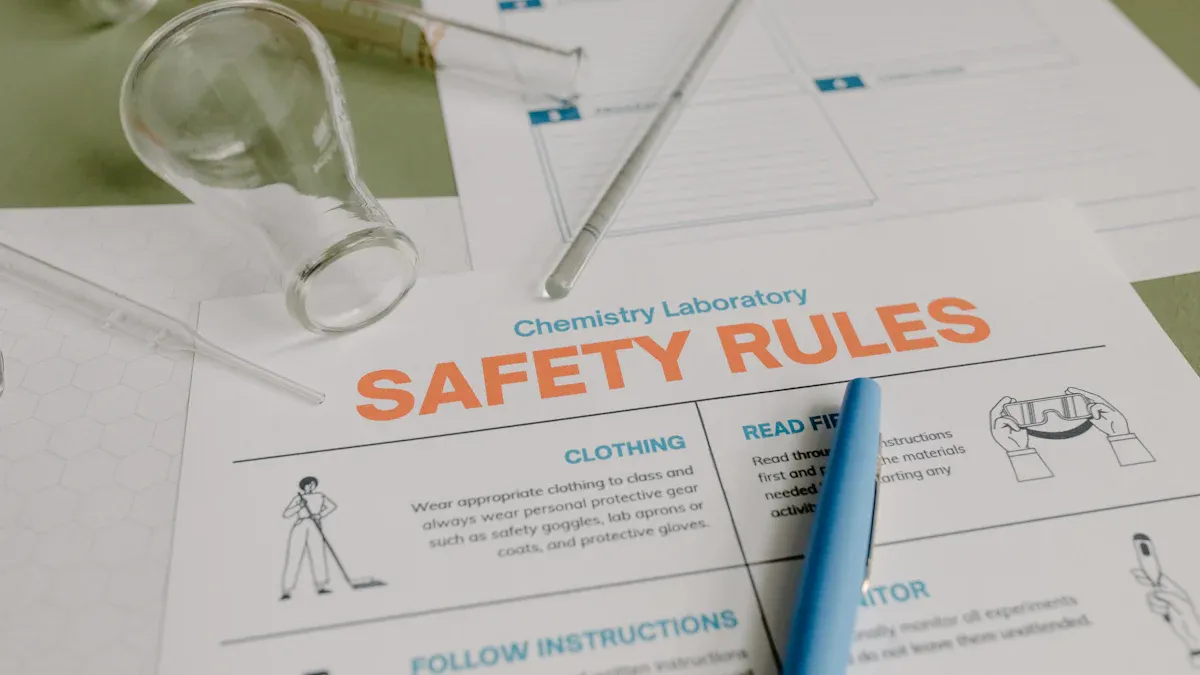
Maintaining an Up-to-Date Inventory
You need to keep your chemical inventory current to support safety in your workplace. Review and update your chemical records often. This helps you track every chemical in each cabinet and prevents mistakes. You should check for missing chemicals or incorrect amounts during audits. Compare your physical inventory with your electronic records to make sure they match. If you find any problems, document them and take action right away. Always follow the rules for labeling, storage, and disposal. Create audit reports that show what you found and what you fixed. Use these reports to improve your chemical storage practices and prevent future errors.
- Review and update chemical documentation regularly.
- Identify and document any discrepancies during audits.
- Reconcile physical inventory with electronic records.
- Ensure compliance with all labeling, storage, and disposal rules.
- Generate audit reports and take corrective actions.
- Improve practices based on audit findings.
Ensuring SDS (Safety Data Sheets) Accessibility
You must make sure every worker can reach Safety Data Sheets (SDS) for all chemicals in your cabinets. These sheets give important safety information about each chemical. You should keep SDSs in a place where everyone can find them during every work shift. Train your team on how to use and locate SDSs, especially when you add new chemicals to your storage cabinets. Keep a list of all chemicals to help you find the right SDS quickly. You must keep SDSs for 30 years after the last use of a chemical.
| Requirement | Description |
|---|---|
| Immediate Access | Workers must have immediate access to SDSs for hazardous chemicals in their work area. |
| Maintenance of SDSs | Employers must keep copies of required SDSs in the workplace and ensure access during each shift. |
| Training | Employees must learn how to locate and use SDSs at assignment and when new hazards appear. |
| Chemical Inventory | Keep a list of chemicals to help locate SDSs. |
| Retention Period | Maintain SDSs for 30 years from the last date of use. |
Verifying Labeling and Documentation Compliance
You must check that every chemical container and cabinet has the right label. Labels should show the chemical name, hazard warnings, and manufacturer details. This helps everyone understand the risks and follow safety rules. During audits, review the organization of your chemical storage rooms, check all container labels, and confirm that only authorized people handle chemicals. Make sure sanitizer management follows your safety plan. Keep Material Safety Data Sheets (MSDS) for each hazardous chemical in your cabinets. These sheets give you the information you need for safe handling, storage, and emergency actions.
Tip: Good labeling and records make your chemical storage cabinets safer and help you pass inspections.
Inspection, Maintenance, and Training for Chemical Storage Cabinets
Scheduling Regular Cabinet Inspections
You need to inspect your chemical storage cabinets often to keep your workplace safe. Inspections help you find problems before they cause accidents. You should follow industry standards for inspection frequency. Use the table below to guide your schedule:
| Frequency | Type of Inspection | Purpose |
|---|---|---|
| Weekly | Visual Inspection | Catch obvious problems quickly. |
| Monthly | Functional Check | Ensure mechanical parts are working properly. |
| Annually | Comprehensive Inspection | Assess long-term structural integrity and document findings. |
Weekly inspections let you spot leaks or broken labels. Monthly checks help you test locks, hinges, and ventilation. Annual inspections give you a chance to review the cabinet’s structure and update your records. You should document every inspection and fix any issues right away.
Performing Routine Maintenance
Routine maintenance keeps your chemical storage cabinets in good condition. You must clean cabinets regularly and check for rust, spills, or damage. Replace broken shelves or seals. Make sure ventilation systems work well. You should test locks and doors to confirm they close tightly. If you find any problems, repair them quickly. Maintenance prevents chemical leaks and protects employee health and safety. Keep a maintenance log for each cabinet. This log helps you track repairs and shows inspectors that you follow safety rules.
Tip: Clean up spills immediately and use absorbent materials to prevent chemical hazards.
Training Employees on Best Practices for Safe Chemical Storage
You need to train every employee who handles chemicals. Training covers chemical inventory, standard operating procedures, safety data sheets, specific chemical risks, and emergency response procedures. You should teach proper storage practices, labeling, and how to respond to emergencies. Employees must learn to segregate incompatible chemicals, use the right cabinet for each chemical type, and store chemicals in secure, ventilated areas.
- Proper storage practices
- Labeling of chemicals
- Emergency response procedures
- Segregate incompatible chemicals to prevent dangerous reactions.
- Use appropriate storage cabinets designed for specific chemical types.
- Ensure chemicals are stored in a secure, well-ventilated area.
Training helps everyone understand safety rules and keeps your chemical storage area safe. You should review training often and update it when you add new chemicals or cabinets.
Emergency Preparedness and Safety in Chemical Storage
Stocking Spill Kits and Personal Protective Equipment (PPE)
You need to prepare for chemical spills in your storage area. Stock each cabinet with spill kits that match the chemicals you store. Choose kits for acids, caustic chemicals, solvents, and aggressive liquids. Place neutralizers for acids and bases in easy-to-reach spots. Always include disposal bags for contaminated materials. Equip your chemical storage cabinets with personal protective equipment. You should have chemical splash goggles, gloves, and an apron or lab coat. In areas with high splash risk, add a face shield and protective clothing. These steps help you protect yourself and others from chemical exposure and improve safety in your storage cabinets.
- Spill kits for acids, bases, and solvents
- Neutralizers for chemical spills
- Chemical splash goggles and gloves
- Aprons, lab coats, and face shields
- Disposal bags for cleanup
Posting and Communicating Emergency Procedures
You must post clear emergency procedures near every chemical storage cabinet. Write simple steps for chemical spills, leaks, or exposures. Train everyone who works near cabinets on these emergency response plans. Make sure all staff know where to find spill kits, emergency showers, and eyewash stations. Mark evacuation routes clearly and keep them open. Post emergency contact numbers for your internal response team and local emergency services. Hold regular meetings to review these procedures. Good communication and clear signs help everyone act fast and stay safe during a chemical emergency.
- Post emergency steps and contact information
- Mark evacuation routes near cabinets
- Train staff on emergency response plan
- Show locations of safety equipment
Conducting Emergency Drills and Response Training
You need to practice your emergency response plan often. Schedule drills based on your risk level. High-risk chemical storage areas need drills every three months. Medium-risk areas should hold drills every six months. Low-risk storage cabinets need at least one drill each year. OSHA, EPA, and NFPA all recommend annual training and drills as a minimum. Use each drill to review your emergency response plan and improve your safety procedures. Keep records of every drill and update your plan as needed. Regular practice helps you respond quickly and safely to any chemical emergency in your storage cabinets.
| Regulatory Body | Recommended Frequency |
|---|---|
| OSHA | Annual refresher training and periodic drills |
| EPA | Annual participation in emergency drills |
| NFPA | Minimum annual drills, more frequently based on risk levels |
Tip: Practice makes your emergency response plan stronger and keeps your chemical storage cabinets safe for everyone.
You build a strong safety culture when you organize, document, and train your team on chemical cabinet storage. Proper handling and storage practices help you prevent accidents and protect your workplace. You keep your cabinets safe by maintaining clear labels, performing regular inspections, and tracking every chemical. Good communication and emergency response training prepare you for any situation. When you follow best practices for chemical storage, you reduce injuries, protect property, and support a healthy environment. Consistent safety efforts in cabinet management make your chemical storage areas secure for everyone.
FAQ
What is the main purpose of chemical storage cabinets?
You use chemical storage cabinets to keep hazardous chemicals safe. These cabinets help prevent spills, fires, and exposure. They also help you follow safety rules and protect everyone in your workplace.
How often should you inspect your chemical storage cabinets?
You should inspect your cabinets every week. Regular checks help you find leaks, broken labels, or other problems. Quick action keeps your storage area safe and compliant.
Can you store all chemicals together in one cabinet?
You should never store all chemicals together. Some chemicals react with others and cause fires or toxic fumes. Always separate incompatible chemicals by hazard class to prevent accidents.
What should you do if a chemical spill happens in a cabinet?
You should use a spill kit right away. Wear protective gear and follow your emergency plan. Clean up the spill and report it to your supervisor. Quick action keeps everyone safe.
Where should you keep Safety Data Sheets (SDS)?
You must keep Safety Data Sheets in a place where everyone can find them. Make sure all workers know how to use them. Easy access helps you respond fast during emergencies.


