

Ductless fume hoods filter laboratory air through activated carbon or HEPA media and recirculate it back into the room — no exhaust duct, no HVAC tie-in required. That single design choice is what makes them genuinely useful in some labs and genuinely wrong for others. Understanding exactly where that line sits keeps you from making an expensive mistake.
At a glance

| Attribute | Detail |
|---|---|
| Filtration method | Activated carbon, HEPA, or specialty canisters; air recirculated in-room |
| Installation requirement | Standard electrical outlet; no ductwork or HVAC penetration |
| Typical applications | Low-concentration solvents, acids, and aqueous solutions within filter rating |
| Chemical compatibility | Determined by filter type — not universal |
| Filter service interval | Varies by chemical load; manufacturer schedules required |
| Regulatory standard | Applicable laboratory ventilation and safety standards require filters to be validated for the specific chemicals used — confirm requirements with your local authority or relevant standard |
| Energy profile | Lower HVAC makeup-air demand than ducted systems; fan motor draw remains |
What Is a Ductless Fume Hood?
A ductless fume hood is a self-contained air-filtration enclosure used in laboratory settings to protect workers from chemical vapors, aerosols, and fine particulates. Instead of exhausting contaminated air outside the building, the unit pulls lab air through internal filter media and returns cleaned air to the room.
They are common in laboratories where renovation or building access is limited — and anywhere a full ducted installation isn’t feasible.
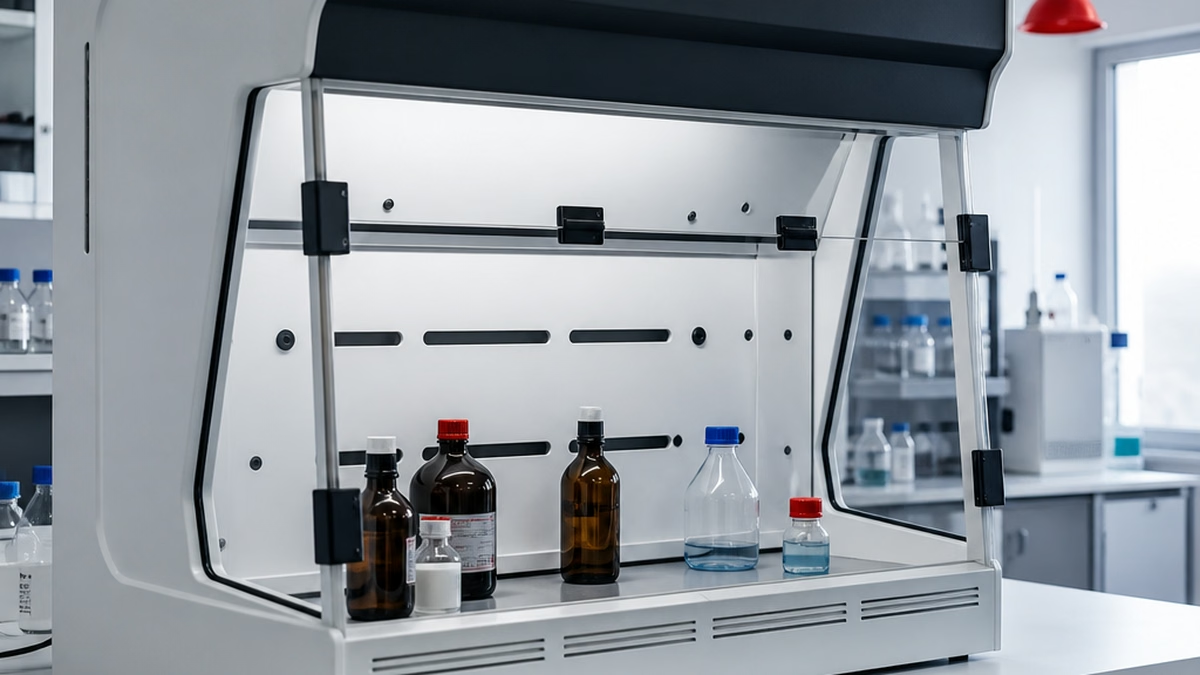
Basic Working Principle of Ductless Filtration
The airflow path is straightforward. A blower draws air through the front opening of the hood, passes it through one or more filter stages, then discharges filtered air back into the laboratory.
Filter stages typically include a pre-filter for particulates, an activated-carbon canister matched to specific chemical families, and sometimes a HEPA layer for biological or fine-dust applications. Relevant laboratory ventilation standards generally require that any recirculating hood be validated against the actual chemicals used — the filter chemistry has to match the hazard, not just the hood model.
Confirm the exact requirements with your local authority or the applicable standard.
⏱️ Time saver: Because ductless hoods run on a standard 120V outlet and need no duct penetration, a comparable ductless unit can be operational in a single afternoon, whereas an equivalent ducted system installation can take a week or more.
Advantages of Ductless Fume Hoods
Easier Installation Without Ductwork
This is the most immediate practical benefit. Ducted fume hoods require a dedicated exhaust duct routed through walls or ceilings, a roof penetration, and coordination with HVAC contractors. Ductless fume hoods skip every step of that.
For a university teaching lab retrofitting a new chemistry station, or a quality-control lab inside a manufacturing facility with a sealed ceiling plenum, that difference can be the deciding factor. Installation reduces to positioning the hood, plugging into a standard outlet, and confirming airflow with a velocity meter at the face.
Flexible Placement and Relocation
Because ductless hoods have no fixed exhaust connection, they can be repositioned as lab layouts change. Move the bench, move the hood.
This matters more than it sounds in active research environments. Labs reorganize around projects, not the other way around. A ducted hood is anchored to its duct drop; a ductless fume hood can follow the workflow to a new bench location without construction work.
⚖️ Trade-off: Relocation flexibility is real, but the filter canister travels with the unit — check that the new location’s chemical inventory still falls within the installed filter’s validated range before you move it.
Reduced Energy Demand Compared with Some Ducted Systems
Ducted fume hoods continuously exhaust conditioned lab air outside the building. That exhausted air must be replaced with tempered makeup air — a significant and ongoing HVAC energy cost.
Energy benchmarking analyses for laboratory buildings generally indicate that fume hood exhaust can be among the larger single energy loads in research facilities, though figures vary by building and usage — consult relevant energy benchmarking resources and confirm with local data.
Ductless hoods recirculate air. The fan motor draws power, but there’s no continuous makeup-air penalty. In labs running multiple hoods, that difference in energy efficiency is measurable on a utility bill.
Controlled Filtration for Suitable Applications
Within their validated chemical range, ductless fume hoods deliver reliable containment. A hood equipped with an acid-gas canister handles low-concentration hydrochloric or sulfuric acid work effectively — a ductless fume hood for acids in that configuration performs as designed.
Similarly, a carbon-loaded unit rated for organic solvents handles routine solvent work at concentrations below the filter’s saturation threshold. The containment isn’t inferior to a ducted hood for those specific chemicals — it’s just bounded by the filter chemistry.
Limitations of Ductless Fume Hoods
Limited Chemical Compatibility
This is the most consequential limitation, and the one most often underestimated.
No single filter canister handles every chemical. Carbon filters are rated by chemical family — an acid-gas canister won’t adequately capture organic solvent vapors, and vice versa. Some compounds — formaldehyde at low concentrations, certain amines, very light gases — pass through activated carbon media with minimal retention.
Laboratories working with unknown mixtures, high-vapor-pressure solvents, carcinogens, or acutely hazardous chemicals should exercise caution with ductless fume hoods — manufacturer validation for each specific compound is strongly advisable before relying on a ductless configuration.
Applicable employer obligations under occupational safety regulations generally require adequate engineering controls, and a filter mismatch may not satisfy those requirements — confirm the specific rules with your local authority or the relevant OSHA standard.
Ductless fume hoods for solvents or ductless fume hood for acids are appropriate categories, but only when the specific solvent or acid is within the stated filter capability.
📌 Remember: “Ductless” doesn’t mean “works with anything.” Match the filter canister type to your specific chemical inventory before purchase — not after.
Filter Replacement Requirements
Carbon filters saturate over time. Once saturated, they stop capturing vapors — and unlike a clogged HEPA filter, a saturated carbon canister doesn’t necessarily trigger a pressure drop or an obvious alarm. The hood may appear to be running normally while providing no chemical protection.
Filter service intervals depend on chemical load, concentration, and usage hours. Some manufacturers include end-of-service-life indicators, but those indicators are chemical-specific and can miss breakthrough for compounds the indicator wasn’t calibrated for.
Maintenance schedules for ductless fume hood filters must be treated as safety-critical, not just routine upkeep. Lab managers who inherit a ductless hood without a service log are operating with unknown filter capacity. That’s an actual laboratory safety risk, not a theoretical one.
⚖️ Trade-off: Lower installation cost trades against an ongoing filter replacement budget. In high-usage applications, cumulative filter costs over time can be substantial and may approach or exceed the original unit price — review manufacturer cost data and your expected usage profile before committing to a ductless configuration.
Performance Depends on Correct Application
Ductless fume hoods work within a defined envelope. Push outside it — wrong chemicals, excessive vapor concentrations, incorrect face velocity, or an overloaded filter — and containment fails.
The performance question (“do ductless fume hoods work?”) has an honest answer: yes, reliably, when the application matches the design parameters. For routine analytical chemistry, low-concentration acid work, or laboratory safety cabinet selection applications within validated chemical families, ductless hoods offer real, verified containment.
They are not appropriate as general-purpose fume hoods in a research environment where the chemical inventory changes frequently, or where high-hazard compounds are in regular use. In those settings, ducted fume hoods remain the correct choice because the exhaust path is unconditional — it doesn’t depend on filter chemistry alignment.
Lab managers evaluating ductless fume hoods for laboratories should treat the chemical compatibility review as the primary decision gate, not an afterthought. Get the list of chemicals, concentrations, and daily use frequencies in front of the hood manufacturer before specifying the unit. That single step prevents the most common — and most costly — misapplication we see in the field.
Have a project or a spec sheet in hand? Talk to huanawell.com — real engineers answer.
Frequently asked questions
Can a ductless fume hood replace a traditional fume hood?
Not always. A ductless fume hood can replace a traditional ducted hood only when the chemicals, application, and filtration system are within the manufacturer’s validated operating range. Applications involving unknown chemicals, highly hazardous substances, or large volumes of volatile solvents may require a dedicated exhaust system.
How often do ductless fume hood filters need to be replaced?
Filter replacement frequency depends on the chemical type, concentration, usage time, and filter loading rate. Unlike ducted systems that exhaust contaminants continuously, ductless hoods retain contaminants in the filter media, so monitoring filter condition and following manufacturer replacement recommendations are essential.
What chemicals should not be used in a ductless fume hood?
Chemicals that exceed the filter capacity, highly toxic substances, radioactive materials, and applications generating large amounts of hazardous vapors may not be suitable. Chemical compatibility should always be verified using the filter manufacturer’s chemical resistance data before use.
Sources
[1] ANSI/ASSP Z9.5-2022: Laboratory Ventilation — blog.ansi.org
[2] Best Practices Guide: Benchmarking Energy Efficiency in … — eta-publications.lbl.gov
[3] 1910.1450 – Occupational exposure to hazardous … — osha.gov
[4] 1926.150 – Fire protection. | Occupational Safety and … — osha.gov
[5] The application of ductless hoods in laboratories — sciencedirect.com


