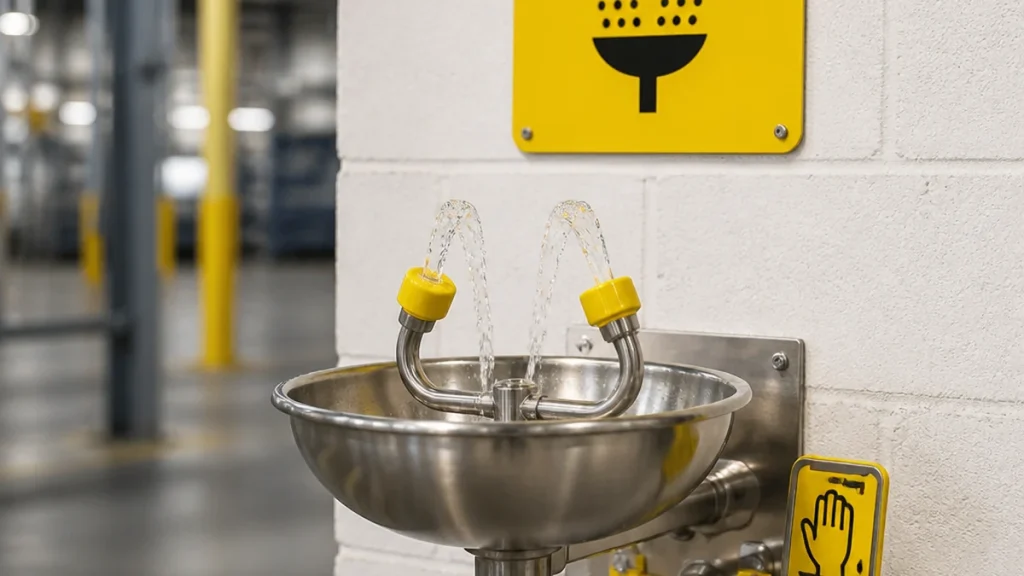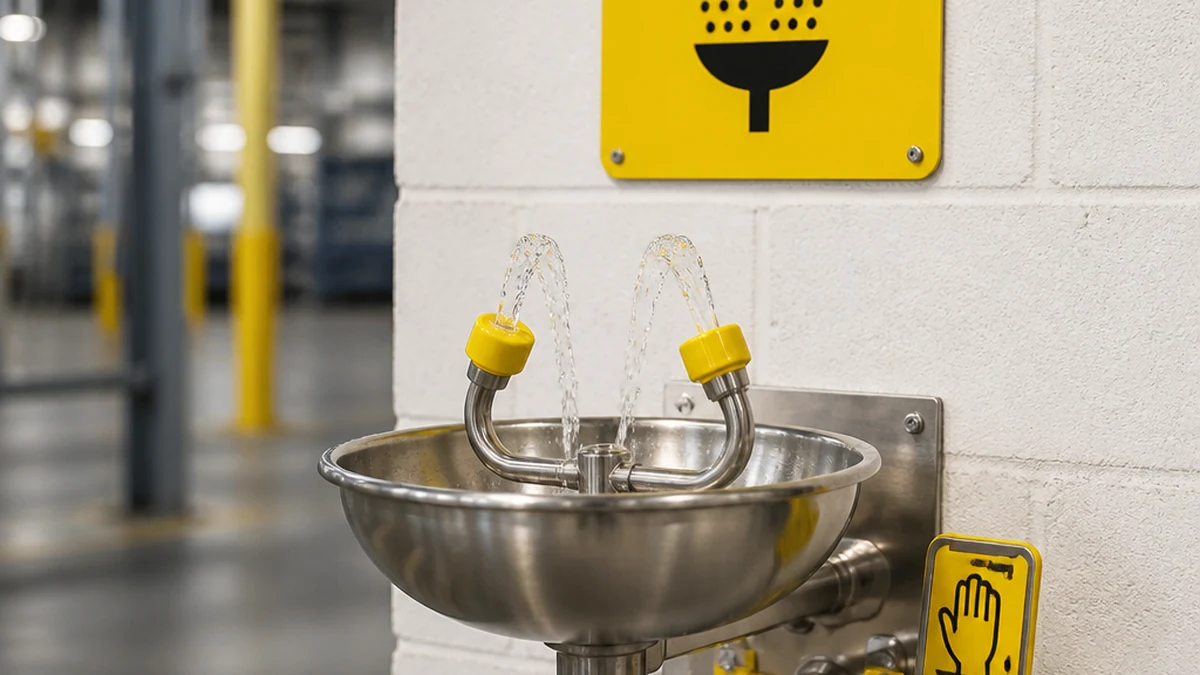
Facilities where employees may be exposed to injurious corrosive materials must provide suitable emergency flushing facilities under OSHA 29 CFR 1910.151(c). ANSI/ISEA Z358.1 provides recognized technical guidance for eyewash equipment performance and installation. This guide explains the OSHA requirement, key ANSI/ISEA Z358.1 criteria, how to choose and install the right wall mounted eyewash station, and how to establish a practical maintenance schedule.
The single most expensive mistake a safety manager makes is mounting a unit in the right building but the wrong location — too far from the hazard, at the wrong height, or fed by a supply line that can’t sustain the required flow rate. An OSHA inspector won’t give credit for “close enough.”
What a Wall Mounted Eyewash Station Actually Does — and When You Need One
A wall mounted eyewash station is a permanently installed emergency eyewash device fixed to a wall, delivering a controlled stream of flushing fluid to both eyes simultaneously for a minimum 15-continuous-minute flush. Models such as the ZYES06-S wall mounted eyewash are designed for emergency flushing in hazardous workplaces. Its primary protective function is to help dilute and remove contaminants from the eyes immediately after exposure. That flushing action can reduce injury severity before medical treatment begins.
Video: ZOYET Stainless Steel Emergency Eyewash Station
Chemical and particulate hazards that trigger the requirement
OSHA requires emergency eyewash equipment wherever employees may be exposed to injurious corrosive materials. That phrase covers a wide range of real-world hazard areas:
- Acids and bases — battery maintenance bays, chemical labs, metal plating lines, and janitorial supply rooms where concentrated cleaners are handled
- Solvents and organic chemicals — paint mixing stations, adhesive application areas, and printing facilities where splash exposure risk is continuous
- Dust and particulates — woodworking shops, cement facilities, and grinding stations where fine particles can lodge in the cornea
- Biological and medical hazards — hospital laboratories and research facilities handling blood, reagents, or formalin
Review the chemical’s Safety Data Sheet (SDS), particularly its hazard identification, first-aid measures, and exposure controls, alongside the workplace exposure assessment. Eye protection requirements alone do not automatically establish an emergency eyewash requirement under OSHA 29 CFR 1910.151(c). Where an emergency eyewash is needed, consider the exposure frequency, hazard severity, available water supply, and maintenance conditions when choosing between a permanent supply-fed station and a compliant self-contained unit.
How a plumbed wall mount differs from portable and combination units
Permanently installed stations connect directly to the facility’s water supply, allowing them to deliver continuous flushing fluid when the plumbing system provides adequate flow and pressure. That’s a key advantage over portable eyewash stations, which carry a finite supply of flushing fluid and require appropriate reservoir maintenance.
The tank volume on these units varies by model; verify that any portable unit you select carries enough fluid to sustain the required 0.4 GPM flow rate for the full 15-minute flush — which requires a minimum of 6 gallons — and confirm the manufacturer’s documentation supports that claim.
| Feature | Wall Mounted (Plumbed) | Portable Self-Contained | Combination Unit |
|---|---|---|---|
| Water supply | Continuous (building line) | Fixed reservoir (limited) | Continuous (plumbed) |
| Flush duration | Unlimited | Limited by tank volume | Unlimited |
| Installation required | Yes — plumbing + mounting | No | Yes — plumbing + mounting |
| Best use case | Permanent hazard areas | Remote or temporary sites | High-risk areas needing body coverage |
| ANSI/ISEA Z358.1 compliant | Yes, if spec’d correctly | Yes, if maintained | Yes, if spec’d correctly |
Portable stations can be a practical choice for remote construction sites or temporary work areas where installing a supply line isn’t feasible. In permanent facilities with ongoing chemical hazards, a supply-fed wall mount may offer easier access to continuous flushing water, provided the plumbing system is properly designed. For a broader comparison of equipment specifications and purchasing considerations, refer to our emergency shower and eyewash procurement checklist.
⚖️ Trade-off: A permanently installed wall mount costs more upfront than a portable unit, but it eliminates the ongoing cost and compliance risk of monitoring fluid levels and replacing expired preservative solution — a maintenance task that portable stations require periodically regardless of use. Consult the manufacturer’s documentation and your applicable standard for the specific replacement interval that applies to any unit you operate.
OSHA and ANSI Requirements That Govern Wall Mounted Eyewash Stations
Two important documents guide emergency eyewash compliance in the United States. OSHA 29 CFR 1910.151(c) establishes the federal regulatory requirement for suitable facilities that allow quick drenching or flushing of the eyes and body where employees may be exposed to injurious corrosive materials. ANSI/ISEA Z358.1 provides recognized technical guidance on emergency eyewash performance, installation, and maintenance. Although OSHA has not incorporated every ANSI/ISEA Z358.1 provision into this regulation, the standard can help employers evaluate whether their emergency flushing facilities are suitable for workplace hazards.
OSHA 29 CFR 1910.151(c) does not specify detailed equipment dimensions, flow rates, or water temperature ranges. Simply installing an eyewash station, however, does not automatically establish that a facility meets OSHA’s requirement for suitable emergency flushing equipment. ANSI/ISEA Z358.1 addresses performance factors such as flow rate, water temperature, nozzle height, accessibility, and flushing duration. Employers should assess these factors alongside their specific workplace hazards and applicable regulatory requirements.
OSHA evaluates whether emergency flushing facilities provide suitable protection under 29 CFR 1910.151(c). In its official OSHA guidance, the agency explains that its regulation does not establish specific flow-rate requirements and that ANSI provides detailed equipment guidance. Compliance with every provision of ANSI/ISEA Z358.1 is not automatically a separate federal OSHA requirement.
ANSI/ISEA Z358.1-2014 (R2020) is a recognized performance standard for emergency eyewash and shower equipment. Confirm the applicable edition with ISEA or your authority having jurisdiction, as editions and local requirements may differ. The standard covers supply-fed eyewash stations, eye/face wash stations, self-contained units, combination shower/eyewash equipment, and personal wash units.
Flow rate, flush duration, and water temperature mandates
ANSI/ISEA Z358.1 sets minimum flow rates by equipment type:
- Eyewash stations (eye coverage only): 0.4 gallons per minute (GPM) for a minimum of 15 continuous minutes
- Eye/face wash stations: 3.0 GPM for 15 minutes (see eye/face wash flow requirements).
- Combination drench shower + eyewash: the shower head requires a minimum of 20 GPM and the eyewash requires a minimum of 0.4 GPM, and both must be delivered simultaneously — confirm these figures against the current edition of ANSI/ISEA Z358.1 or your authority having jurisdiction, as the applicable version in your facility governs
Tepid water is mandatory. The standard defines a tepid temperature range intended to keep water comfortable enough that an injured worker will complete the full 15-minute flush. Water that is too cold causes involuntary eye closure; water that is too hot can accelerate chemical absorption. The tepid range specified in ANSI/ISEA Z358.1 is the controlling requirement; confirm the exact figures with the current edition of the standard or your authority having jurisdiction before commissioning any installation.
In most U.S. facilities, meeting this requirement means actively verifying supply line temperature rather than assuming it.
Accessibility and travel-distance rules under ANSI Z358.1
ANSI/ISEA Z358.1 generally calls for emergency eyewash equipment to be accessible within approximately 10 seconds of the hazard, along an unobstructed travel path. This should not be treated as a universal fixed-distance allowance for every facility. Actual placement must account for the severity of the chemical hazard, workplace layout, potential obstacles, and applicable safety requirements. Particularly hazardous exposures may call for equipment positioned immediately adjacent to the work area.
The path must be:
– Level (no stairs between hazard and station)
– Free of obstructions that a disoriented or vision-impaired worker couldn’t navigate
– In the same area or immediately adjacent space — not across a building corridor
For highly corrosive materials — concentrated sulfuric acid, hydrofluoric acid, strong lye — Z358.1 recommends positioning the station within the immediate work area itself, not at the outer boundary of the maximum travel distance. That distinction matters when mapping a new chemical handling space.
📌 Remember: The 10-second rule governs the travel path, not the floor distance. Obstructions, blind corners, and changes in floor level all add time to the actual route. Walk the path yourself with a stopwatch before calling placement compliant.
Documentation and inspection recordkeeping obligations
ANSI/ISEA Z358.1 calls for weekly activation of plumbed eyewash stations to verify proper operation and flush stagnant water from the supply line. Maintaining a written or digital record of weekly activations is a useful safety management practice. Records should include the inspection date, responsible personnel, observed operating conditions, and corrective actions. OSHA 29 CFR 1910.151(c) does not explicitly prescribe a weekly activation log format.
Annual inspections must verify that the unit meets current standard specifications — flow rate, spray pattern, activation force, and water temperature. Many facilities contract these annual checks to certified third-party safety equipment services. Keeping a compliance maintenance annual report documenting both weekly logs and annual certification results is the cleanest paper trail if a citation dispute arises.
Choosing the Right Wall Mounted Unit for Your Specific Workspace
The appropriate emergency eyewash equipment depends on the workplace hazard assessment, including the type and severity of the chemical exposure and whether contamination could affect only the eyes or also the face and body. Our guide to eyewash station selection explains these considerations in greater detail. Where the assessed risk is limited to eye exposure, a standard eyewash station designed to deliver at least 0.4 GPM may be appropriate.
A scenario involving bulk liquid, pressurized release, or immersion risk requires an eye/face wash at 3.0 GPM, or a combination unit if body contamination is credible. Getting that determination right before specifying equipment is what separates a defensible hazard assessment from a unit that looks compliant but isn’t.
Single-head vs dual-head configurations
Standard wall mounted eyewash stations have two nozzles — one per eye — that activate simultaneously with a single hands-free push. That’s the baseline configuration for most facilities.
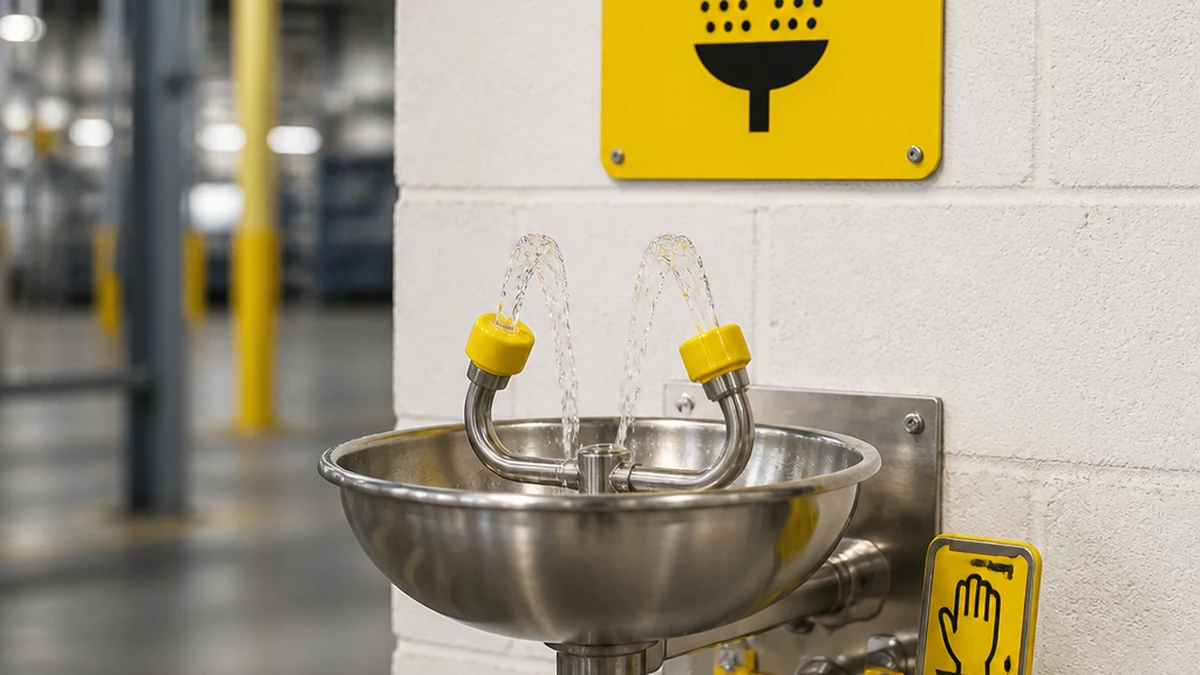
Dual-head (or dual-station) units mount two independent eyewash heads on a single wall bracket, allowing two workers to flush simultaneously. These are appropriate for high-density work areas — chemical batching lines or busy lab benches — where two exposures could realistically occur at the same time. They draw more water volume, so supply line capacity needs checking before installation.
For most single-worker hazard areas, a standard single-station supply-fed unit meets both Z358.1 requirements and practical need. A dual-head unit in a one-person work cell complicates maintenance without adding safety value.
Freeze-protection and heated models for cold environments
Standard supply-fed eyewash equipment fails in unheated facilities — loading docks, cold storage areas, outdoor equipment yards — because standing water in the supply line or bowl freezes, blocking flow or bursting fittings.
Two design approaches address this:
- Freeze-protected (self-draining) units: the bowl and supply section drain automatically when the station is off, preventing standing water from freezing. These work well in spaces that drop below 32°F periodically but aren’t continuously sub-freezing.
- Heated (thermostatic) units: a built-in electric heater or heat-traced supply line maintains tepid water temperature year-round. Required for outdoor installations in northern U.S. climates or refrigerated warehouses.
Facilities in states with hard winters — Minnesota, Wisconsin, the Dakotas — frequently mis-specify a standard indoor unit for a dock area. The result: the unit freezes solid mid-winter, fails its weekly activation check, and creates both a compliance gap and a repair bill.
Combination eyewash-and-drench-shower units
A combination unit mounts both an overhead drench shower and an eyewash station on a single supply-fed assembly. Z358.1 requires combination coverage when both eye/face and body contamination are credible risks — chemical splash scenarios where a bulk spill or pressurized release could soak clothing and skin, not just the face.
Common applications include drum decanting stations, chemical mixing rooms, and any area where workers handle containers larger than one liter of concentrated corrosives.
The shower head requires a minimum of 20 GPM and the eyewash requires a minimum of 0.4 GPM, and both flows must be sustained simultaneously — confirm these figures with the current edition of ANSI/ISEA Z358.1 or your authority having jurisdiction. Supply line sizing must support both flows together, and the floor drain beneath the unit must handle the combined flow without flooding.
Step-by-Step Installation: Getting Placement and Plumbing Right
Locating the unit within the 10-second travel path
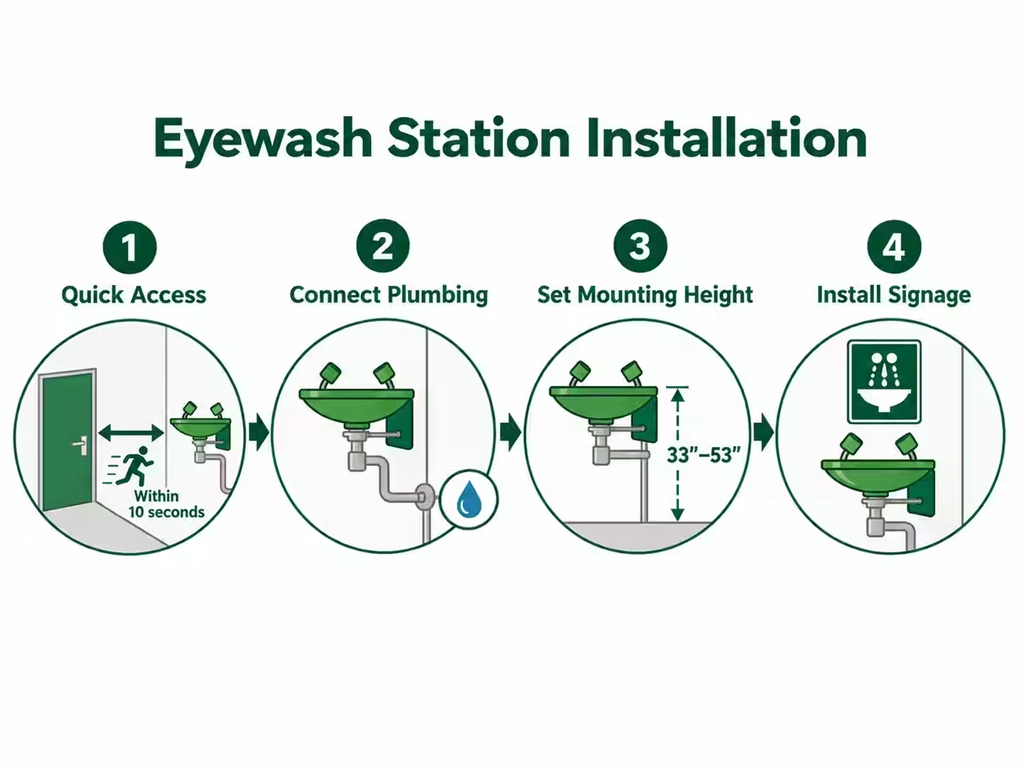
Before picking up a drill, walk from every chemical hazard point and time the route to the proposed installation wall. Count doorways and other obstacles: each one adds time in a real emergency, and a disoriented or vision-impaired worker will move more slowly than you expect. The station must be on the same level as the hazard — no stairs, no ramps that slow movement.
Mark the proposed location on the floor plan and show the travel path. If any hazard point exceeds 10 seconds, you need a second station or a relocated one. This mapping step, done before mounting, avoids the expensive problem of discovering the wall mounted eyewash station is non-compliant after the plumbing is already in.
Plumbing connection requirements and water pressure checks
ANSI/ISEA Z358.1 doesn’t mandate a specific inlet size. Wall mounted eyewash stations vary by manufacturer, so confirm the required supply connection size and inlet pressure specifications in the unit’s installation documentation before connecting. Before commissioning:
- Verify static water pressure at the supply tap meets the manufacturer’s minimum inlet requirement to deliver compliant flow at the nozzle
- Check that the supply line can sustain flow for 15 minutes without pressure drop (relevant in facilities with low-pressure domestic water systems)
- Confirm tepid water is available at that tap, or plan for a thermostatic mixing valve to blend hot and cold to the required temperature range — confirm that range with the current edition of ANSI/ISEA Z358.1
Connect to a dedicated supply valve so maintenance staff can isolate the unit without shutting down other facility systems. Install a floor drain — or verify an existing drain handles the full 0.4 GPM (or 3.0 GPM for eye/face wash) flow continuously without backing up.
⏱️ Time saver: If a thermostatic mixing valve is needed to maintain tepid flushing water, plan for it during the initial plumbing design rather than retrofitting it later. Early planning can help avoid additional labor, equipment changes, and disruption associated with modifying the water supply system after installation.
Mounting height, clearance, and identification signage
ANSI/ISEA Z358.1 specifies nozzle height and clearance requirements to keep the station accessible to a crouching or disoriented worker. The nozzle must be positioned 33 to 53 inches above the finished floor, and a minimum clearance of 6 inches must be maintained from adjacent walls or obstructions. For additional placement and accessibility considerations, see our eyewash installation guidelines. Confirm the applicable dimensions with the current edition of ANSI/ISEA Z358.1 or your authority having jurisdiction before mounting.
Clearance in front of the unit must allow the user to stand or kneel without bumping into equipment, shelving, or doors. The required clear floor space in front of the station is specified in ANSI/ISEA Z358.1; consult the standard directly to confirm the applicable dimension rather than relying on informal rules of thumb.
Identification signage is required by Z358.1 — a highly visible sign must mark the station’s location and be readable from across the hazard area. Green-and-white safety signs with the internationally recognized eyewash pictogram meet this requirement. The sign must remain unobstructed; placing equipment or shelving in front of it is a citation-ready condition inspectors note frequently.
Weekly, Monthly, and Annual Maintenance Routines That Keep You Compliant
Most facilities understand that eyewash stations need periodic attention. What they may underestimate is the importance of regular activation and inspection. ANSI/ISEA Z358.1 calls for weekly activation of plumbed eyewash equipment to verify proper operation and flush stagnant water and accumulated sediment from the supply line. Regular maintenance also supports water hygiene, although microbial risks, including Legionella, depend on the water system and operating conditions. Weekly activation should be supported by routine inspections and documented corrective actions.
Weekly activation flush — purpose and logging
Activate the eyewash station every week, without exception. Confirm the unit flows freely at adequate pressure and that both nozzles produce a centered, unobstructed spray pattern.
Each weekly activation log entry should capture:
- Date and time of activation
- Name of person performing the check
- Observed flow quality (both nozzles active, spray pattern centered, no drips or blockages)
- Water temperature (approximate — hot, cold, or tepid)
- Any corrective action taken
A paper logbook kept at the station is acceptable; a digital log in a facility safety platform is better, because it’s harder to lose and easier to present during an OSHA inspection.
Monthly inspection checklist items
Monthly checks go beyond the activation flush. A compliance and maintenance manager or designated safety rep should verify:
- Nozzle covers intact and free of debris (these protect the nozzle from contamination between uses)
- Bowl and drain clear — no accumulation of dust, grease, or particulate
- Activation handle or paddle moves freely and stays latched in the open (hands-free) position
- Signage visible and unobstructed
- Water temperature at the nozzle confirmed within the tepid range specified by ANSI/ISEA Z358.1, using a thermometer
- Supply line — no visible corrosion, leaks, or loose fittings at the wall connection
Any deficiency found during monthly inspection is a corrective action item. Document both the finding and the correction date — best practices in compliance management treat open deficiencies without a close-out date as unresolved citations waiting to happen.
Annual third-party or certified inspection requirements
The annual inspection verifies items the weekly flush cannot: precise flow rate at the nozzle, spray pattern geometry, activation force, and sustained tepid water temperature under load. The review should include:
- Flow rate measurement (must meet or exceed 0.4 GPM for eyewash, 3.0 GPM for eye/face wash)
- Spray pattern verification (both heads activating, correct coverage area)
- Activation force and timing check — ANSI/ISEA Z358.1 sets general requirements for how readily a station must activate; confirm the specific criteria with the current edition of the standard or your authority having jurisdiction
- Tepid water temperature verification under sustained flushing conditions
The resulting annual inspection report can become part of the facility’s formal safety documentation. Documented inspections provide useful evidence that emergency eyewash equipment has been evaluated and maintained. Missing inspection records may complicate a facility’s ability to demonstrate proper upkeep, but they should not automatically be equated with the absence of required eyewash equipment.
Common Installation and Maintenance Mistakes That Trigger Citations
The same failure patterns appear in OSHA citations across industries. Knowing them in advance is cheaper than learning them from an inspector.
Placement beyond the 10-second path is the top citation trigger. Facilities measure floor distance instead of travel time, place units across doorways, or install them in adjacent rooms “for convenience.” None of those pass Z358.1 scrutiny.
No tepid water. Connecting to a cold-only supply line — common in older buildings where hot water was never run to the work area — produces water well below the required tepid range. Workers won’t maintain a 15-minute flush in near-freezing water, and inspectors know it.
Blocked access. Drums, pallets, or stored equipment in front of the station create an instant citation. The path must be clear at all times, not just on inspection day.
Missing or incomplete weekly logs. Incomplete maintenance records make it harder to demonstrate that eyewash equipment is routinely inspected and maintained, although missing logs alone do not automatically establish a violation of OSHA 29 CFR 1910.151(c). Facilities relying on informal verbal confirmation rather than documented checks may also struggle to identify recurring equipment problems and track corrective actions.
Mounting outside the required nozzle height range. Contractors unfamiliar with Z358.1 sometimes mount the unit at a comfortable working height for installation — which is often too high for a person bent forward in pain. The nozzle must be positioned 33 to 53 inches above the finished floor; confirm this specification with the current edition of ANSI/ISEA Z358.1 before mounting.
Audit Your Facility and Take the Next Compliance Step
Walk your facility with a stopwatch and a copy of ANSI/ISEA Z358.1. Start at every point where hazardous materials are handled and time the path to the nearest wall mounted eyewash station. Mark any hazard area that takes more than 10 seconds to reach. That map is your compliance gap list.
Then check your maintenance records. If weekly activation logs have gaps, or if the last documented annual inspection is more than 12 months old, those are corrective actions that belong on a formal timeline.
When specifying a replacement or additional unit, request the manufacturer’s ANSI/ISEA Z358.1 conformity documentation, relevant performance test reports, installation instructions, and any applicable third-party certification records. Verify that the equipment can deliver the required flushing performance under actual site conditions. For cold-environment installations, confirm the freeze-protection capabilities against the lowest expected ambient temperatures and the facility’s water supply conditions.
OSHA citations under 29 CFR 1910.151 can carry significant financial penalties, and willful or repeat violations are treated more severely. Confirm the current penalty structure with OSHA or qualified legal counsel, as penalty amounts are subject to periodic adjustment. The audit takes an afternoon. Getting it done before the next inspection cycle is the straightforward call.
Have a project or a spec sheet in hand? Talk to huanawell.com — real engineers answer.
Frequently asked questions
What does a wall mounted eyewash station actually do, and when do you need one?
A wall mounted eyewash station delivers a controlled flow of tepid flushing water to both eyes simultaneously, helping remove hazardous substances following exposure. OSHA 29 CFR 1910.151(c) requires suitable emergency flushing facilities where employees may be exposed to injurious corrosive materials. ANSI/ISEA Z358.1 provides recognized technical guidance, including the general recommendation that eyewash equipment be accessible within approximately 10 seconds of the hazard. The appropriate equipment and placement should be determined through a workplace hazard assessment.
What chemical and particulate hazards trigger the eyewash station requirement?
OSHA 29 CFR 1910.151(c) requires suitable emergency flushing facilities where employees may be exposed to injurious corrosive materials, including certain concentrated acids and caustic alkalis. Other hazards, such as solvents, irritants, and airborne particulates, may also justify eyewash equipment based on the workplace risk assessment or other applicable requirements. Review the chemical’s Safety Data Sheet, particularly Sections 2, 4, and 8, but do not treat an eye protection warning alone as automatic proof that an emergency eyewash station is legally required.
How does a plumbed wall mount differ from portable and combination units?
A plumbed wall mounted eyewash connects directly to a facility’s water supply and is designed to deliver at least 0.4 gallons per minute for a minimum of 15 minutes under ANSI/ISEA Z358.1. Portable self-contained units use a finite supply of flushing fluid and may be suitable for temporary, remote, or permanent work areas when their performance and maintenance meet applicable requirements. Combination units integrate eyewash and emergency shower functions for hazards involving both eye and body exposure. The best configuration depends on the workplace hazard assessment, water supply, installation conditions, and maintenance capabilities.
Sources
[1] Medical Services and First Aid — 29 CFR 1910.151 — osha.gov
[2] ANSI Z358.1 Guidance for Emergency Eyewash and Shower Facilities — osha.gov
[3] ANSI/ISEA Z358.1-2014 (R2020): Emergency Eyewash and Shower Equipment — webstore.ansi.org